Business
From United State, Canada: How dangerous ‘Tokunbo’ enter Nigeria roads

•Unsuspecting Nigerians buy to their detriment
At exactly the point where his life seemed to be taking shape, 28-year-old Star Okigwe watched it stall.

Fresh out of the National Youth Service Corps, NYSC, and newly employed by a blue-chip company in Lagos, he had spent 18 months saving for his first car, a foreign-used Toyota he believed would ease his daily commute. Less than three months later, the car broke down on his way to work.
A mechanic’s inspection revealed that the vehicle had been involved in a major accident abroad and poorly repaired after being shipped to Nigeria. The cost of fixing it ran into hundreds of thousands of Naira, leaving him in tears and regret.
Star’s experience is one such case
In 2025, Ekundayo Japheat, a businessman in his late 50s, visited a car lot in Ondo State to purchase a 2018 Toyota RAV4. However, he insisted on engaging the services of a professional mechanic before making any purchase.
During this investigation, he said the decision was shaped by rising fear around accident imports, especially as mechanics complain that such vehicles are becoming difficult to detect and are often passed off as accident-free after repairs.
He told this reporter that “a few months before I bought my car, a friend of mine was about to buy what looked like a brand-new, imported Toyota in Akure. The car was sleek, clean and attractive. He had already fallen in love with it until a skilled mechanic with whom he took to assess the vehicle pointed out that it had been involved in a major accident in the United States. He was unhappy, but at the same time relieved that his money had not been wasted.”
Unlike Japheat’s friend, many unsuspecting Nigerians have fallen victim to purchasing refurbished imported vehicles with hidden accident histories, thereby throwing them into distress and grief.
What are accident vehicles?
Industry authorities such as the National Motor Vehicle Title Information System and the Insurance Information Institute classify accident vehicles, also known salvage vehicles, as those reported as heavily damaged and written off by insurers due to the high cost of repairs.
Automobile experts point to structural integrity failures, sudden mechanical failures, compromised safety systems, hidden damage and corrosion protection breakdown as major issues associated with such vehicles.
According to experts, if such vehicles are improperly repaired, they are at high risk of sudden failures, even while driving.
Supporting this concern, a study conducted by Nigerian researchers found that vehicle quality could be a major determinant of road deaths, even more than road conditions.
The study, titled: ‘A comparative analysis of road and vehicle qualities as factors of road traffic carnage in Nigeria,’ published in 2023 by BMC Public Health, states that for every decrease in vehicle quality, death tolls from road traffic crashes in Nigeria increased.
The researchers observe that “the quality of roads dwindles in Nigeria. Besides, vehicle quality degenerates since second-hand vehicles (or Tokunbo mostly ‘accidented’, that is, previously involved in a terrible accident and adjudged irreparable by insurance companies) replace the choice of new vehicles which have become unaffordable amid towering inflation and lowering the poor exchange rate for Naira. A combination of these factors is the direct cause of unacceptable levels of increase in the number of road traffic crashes and the attendant very high death tolls. Deteriorating vehicle quality results in higher road traffic death tolls than the corresponding decrease in road quality.”
Trading hub
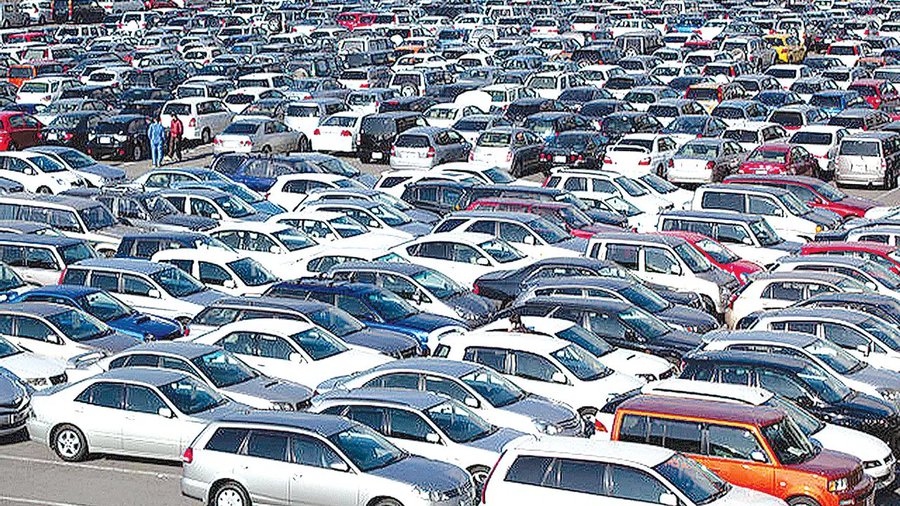
To understand how these vehicles still enter the auto market in Nigeria despite these risks, this reporter visited a major vehicle trading hub in Lagos State.
Time was ticking towards noon on Saturday, April 11, 2026, when I visited Berger Yard, a hub for vehicle sales located not far from the Kirikiri Maximum Security Prison in Apapa, where a friend arranged a meeting with some dealers.
At most of the car lots, which stretch from the old AP filling station up to the bridge connecting the area to Kirikiri, activities were slow.
Clusters of dealers were either playing draught or conversing idly with colleagues beside rows of neatly arranged cars, quickly rising to approach any passerby.
“You wan buy motor?” one called out in Nigerian pidgin, as others moved closer, eager to make a sale. “I wan see my friend,” I responded.
Worrying distinction
During the visit, this reporter met with the Chairman of Higher Dealers Forum, Iyke Onyeka, a veteran in the automobile business with over three decades of experience.
Onyeka categorised imported accident vehicles into two: Major and minor accidents.
Onyeka explained that major accident cars affect critical components of a vehicle, adding that such cars should not be allowed into the country.
According to him, for vehicles with minor accidents, such as damage to the headlamp, bonnet, or bumper, these are changeable components that do not significantly affect the usability of a car.
Speaking to Sunday Vanguard, he said: “These minor ones that come into the country, you repair them and have a complete car to yourself. “Once a car has an accident, whether major or minor, it is cheaper abroad. It is a natural occurrence. For example, if you drive your car and it gets involved in an accident and you want to dispose of it, if you can find someone willing to buy it, you will definitely sell it at a price lower than its original value. I think it is the price that affects the demand for it. “Second, out there in the US, if there is a complete car that is not dented in any way, whether major or minor, the owner will hardly sell it because indigenous Americans are also looking for such cars. They go to bidding points to buy cars, and, most of the time, they go for cars that have not been involved in accidents, which they use in America if they meet their standards.
“Those of us in Africa, especially Nigeria or outside America, will be able to afford more of those accident vehicles. By the time we fix them, we will be able to sell them. Those accident-free ones are very expensive. Even if you bring them here, the price, in comparison with others that have been repaired, is not usually favourable.”
Global village
The automobile dealer, however, dismissed misconceptions that the high exchange rate and biting economy are responsible for the rising influx of accident vehicles.
According to him, at whatever exchange rate, those in the automobile business will always purchase vehicles for sale.
He said: “The only thing is that if the exchange rate is low and I can afford to buy 20 cars, I will do so. If it is very high, I may buy 10. The customer, at the end of the day, will pay for it.
“The world is now a global village. Many people are aware of their environment. Most people will come here, and if they see a car they like, they will take the chassis number and verify how the car came in from the US and check whether it had a minor or major accident. It is at that point they decide to buy or not. The world has become a global village, so you really cannot deceive anybody anymore.”
Profit-making
For another dealer, Christopher Onyebuchi, the rising influx is largely profit-driven.
Onyebuchi, however, said dealers like him do not experience demand for major accident vehicles.
According to him, his customers do not go for such vehicles unless they are unaware that the vehicle was involved in an accident.
Manipulation
Speaking to Sunday Vanguard, he said: “They (customers) carry out checks. If it is an accident vehicle and they find out, the person will abandon it. It is not advisable to buy it because it does not have market value. There are many ways to check through the VIN number, also known as the chassis number.
“When you use the chassis number, you can search for it on your phone and it will bring up the history of the car. However, chassis can be manipulated, but this can only happen with vehicles bought on display in America because those ones are not in the system.
“Accident cars are not up to the standard of non-accident cars. For example, if you are buying a 2006 Toyota Sienna, an accident vehicle, including repairs and shipping, may cost about N7 million, while a standard car may cost about N8.5 million. So, the person who sells accident vehicles makes more profit.”
Asked if there are people who purchase major accident vehicles without knowing, he said: “Yes, all the time.”
Influx
Another car dealer, who did not want to be named, told Sunday Vanguard that in the 1990s, European cars were in vogue in Nigeria, but from the 2000s onward, the US flooded the market with automatic vehicles, leading to an influx of accident vehicles into the country.
His words: “Generally, some accident vehicles are advisable to buy, while some are not. It depends on the extent of the damage.”
The data
Despite the scale of the problem, there is limited publicly available data on how many accident-damaged vehicles enter Nigeria annually.
However, import figures reveal the country’s heavy reliance on foreign-used cars.
Between 2017 and 2022, Nigerians spent over N2.3 trillion on such imports, with a significant portion sourced from the United States.
Also between 2023 and 2025, Nigerians, according to the National Bureau of Statistics, NBS, spent N4.31 trillion on passenger car imports.
While N145 billion was spent in 2017, N269 billion was spent in 2018, N580 billion in 2019, N718 billion in 2020 and N617 billion in 2021.
Likewise, N1.47 trillion was spent on passenger car imports in 2023, N1.26 trillion in 2024 and N1.58 trillion in 2025.
Loopholes
Meanwhile, findings by Sunday Vanguard show that in spite of the risks of bringing in salvage vehicles, Nigeria’s import system does not explicitly prohibit them.
Chairman of the National Association of Government Approved Freight Forwarders, NAGAFF, Dr Segun Musa, told Sunday Vanguard that importing vehicles, whether new or used, follows a standard customs process involving documentation such as Form M, proforma invoices, final invoices, Pre-Arrival Assessment Report, PAAR, and marine insurance.
Musa said used vehicles, including accident vehicles, are assessed based on declared condition and value, which determines duty payable.
He said: “There is a lifespan for vehicles that can come in. Again, government also creates room for accident vehicles that can come in for repair. So, if you have accident vehicles, it is cheaper to clear because the value will depreciate more than the one that is not an accident vehicle. When it arrives in Nigeria after clearance, you can now go ahead and repair it.
“A lot of people, because of the cost implications, prefer bringing in accident vehicles that can be fixed when they arrive in Nigeria. When you are doing your assessment, you have to state the position of the vehicle, the state of the vehicle, so as to justify the value that you are actually putting on it.”
Asked if clearing agents conceal the accident history of these vehicles, he said: “If the accident is not visible, the agent also may not even know. It is only the importer that will be aware of the state of the vehicle. Some vehicles may look new and look good, but the accident part might not be visible.”
Concealing process
In numerous mechanic villages in Lagos, the transformation of accident vehicles takes place daily.
Over a three weeks observation period, this reporter witnessed a structured chain of restoration carried out on such vehicles in one of the mechanic workshops around Vanguard Newspapers headquarters.
The process includes mechanical repair, panel beating and electrical rewiring often erasing visible signs of past damage.
A repairer, who simply gave his name as Japan, with over seven years of experience, demonstrated how severely damaged vehicles are restored.
Short, bulky and fair, he pointed to a Toyota with a damaged radiator and fender, saying: “The one I am currently repairing is an accident car that suffered a major collision. For an accident car to be repaired, it depends on what got spoilt during the collision. In this case, the radiator and fender are bad. This car has radiator and fender problems, which is major work. If you look at it, they will cut this chassis, which is not a small job. They need to cut it very well and change the fender. If it is major work, I collect N800,000 to fix it. The person who purchases it will not see any problem because we would have properly worked on it. It will not be obvious that the car has been worked on unless you come with a mechanic.”
Good car
Tall, dark and slender, a popular auto repairer, who gave his name as Chukwuka with over 20 years of experience, had also been approached by this reporter upon seeing him set to work on a Toyota vehicle that looked irreparable.
Upon asking him if there was a solution to the car, he burst into laughter and said: “100 per cent. The car will be repaired and it will work perfectly. Before we can repair a major accident vehicle and make it look okay, we will need to drop the engine and gear; a panel beater will draw it with his crane. This will enable them to have space to work on the vehicle.
“If the buyer knows how to use Google, he can search for the car by chassis number. If he does not, he will not know whether the engine was in an accident or not. I will not take less than N150,000 to N200,000. Panel beaters also charge separately. I work on Japanese cars. I advise that if one wants to buy a good car, they should not buy from Canada. Their country is salty; it is acidic and corrodes iron.
That is why their cars are rusty. If you ship from Canada, you will spend more money on repairs.”
Least affected part
Simply identified as Striker, he appeared to be in his 30s. He had just finished the day’s work and had gone to fetch water and was preparing to take his bath when this reporter approached him. Unlike the others, he was initially unwilling to talk.
After a few minutes of back and forth, he agreed to share insights with Sunday Vanguard, saying with over seven years of experience, he had noticed that the least affected part of a vehicle in a collision is usually the driver’s side.
He said: “This is because the person driving a motor does not want to suffer an accident. Therefore, he tries to save himself. A major accident takes about two weeks to repair if the owner has money, and a month at most. The capacity to repair an imported accident vehicle is largely dependent on the tools at the mechanic’s disposal.
“If you have a crane that can draw iron, it makes your work easier and faster. There are tools for accident cars, and if you do not have them, you cannot repair such vehicles. If you have the tools, you will not be afraid when they bring such vehicles to you. I repair Benz, BMW, Toyota, Chevrolet and others.
“But I have noticed that Benz accidents are not usually fatal; it is often just a component that is replaced. For Toyota, their accidents are usually fatal. A lot of accident vehicles come in from Canada. After repairs, these vehicles will not show any fault, but that depends on the mechanic who repairs the vehicle. In fact, if you get a good mechanic, the lifespan of such a vehicle will depend on the end user.”
Experts weigh in
Experts expressed worry over the situation and pointedly told Sunday Vanguard that this thriving trade is enabled by regulatory gaps.
For Professor of Transport and Logistics, Bamidele Badejo, systemic failure fuels the desire to purchase such cars and sell to unsuspecting Nigerians because public transportation cannot cater to people’s needs.
Badejo lamented that weak laws and regulations are contributing to the problem.
He, however, warned that while such vehicles can be repaired, restructured and improved upon, the appropriate regulatory authorities must ensure that they are subjected to stricter quality assurance, quality control and MOT tests before being allowed on the country’s roads.
Weak regulations
Speaking to Sunday Vanguard, he said: “We have the regulatory agencies that can check and look at the possibility of allowing or disallowing such a category of imported vehicle in the country. Now, if you see that there is persistence in the bringing in of these vehicles, it shows that those vehicles have failed all MOT tests, quality assurance and quality standards in the United States.
“They cannot be repaired; they are supposed to be taken to the junkyard where they are destroyed. But they now find that they can still make money from these accident vehicles by exporting them to other countries, especially countries whose laws and regulations are weak and do not restrict those types of vehicles coming into our country. If those vehicles could still meet their MOT test quality assurance in the United States, they are not likely to be exported to Nigeria.
“The accident vehicles that are now brought to Nigeria can be repaired, restructured and improved upon, but they must be subjected to stricter standard control, quality assurance, quality control and MOT tests to make sure that such vehicles are roadworthy.
“But in the case of our MOT test, they are mere revenue-generating assessments. The problem is multifaceted, and the approach is also multifaceted. My thinking is that we should start producing our own vehicles just as India, Romania, China and some other countries are doing.
“If we cannot produce, let us invest more heavily in public transportation and rail infrastructure development. If you look at the way things are in the country in terms of bribery, corruption and smuggling, it will be difficult to stop the importation of accident vehicles.”
Hidden dangers
Also sharing his thoughts on the issue, a mechanical engineer, Mr Ossai Jethro, warned that the danger of accident vehicles extends beyond visible repairs.
He said hidden electrical faults, sensor damage and compromised vehicles could pose long-term safety risks.
Jethro, in a chat with Sunday Vanguard, said: “Even after repairs, there might be hidden problems that can cause danger in the long run. Electrical systems specifically. Some sensors might get damaged that might not fail immediately. Sudden failure of those sensors might pose a risk.
“The fact that they can fail suddenly at any point in time makes the risk of road accidents high. Also, accident cars will definitely drop the resale value of all cars drastically. What Nigerians don’t know is that, some of these vehicles are flood cars, not crashed vehicles. Flood cars are dangerous because the electrical systems are already compromised, irrespective of the major repairs being done. Some of these repairs are even ‘cut and join’. If there were actual regulatory bodies to oversee cases like this, it wouldn’t have been rampant.”
Accountability avoided
Meanwhile, National Public Relations Officer of the Nigeria Customs Service, Maiwada Abdullahi, who reacted to experts’ concerns, said: “The issue of quality does not fall within the Customs’ purview. Our responsibility lies in adherence to policy. Government can decide that vehicles above a certain age should not come in. That is a policy decision by government, and ours is to implement it. Our duty is to ensure that if a certain duty is charged on a particular category of vehicle, we collect it.”
Asked if there is a level of damage a vehicle may have suffered before being allowed in, he told Sunday Vanguard: “I don’t know that; I only know age, which is 10 years. What government usually does is provide incentives that would encourage us to first improve our automobile industry within the country. When you look at our automotive policy, you will realise that imported vehicles are charged high duties to discourage their importation, so that you either import Semi-Knock-Down, SKD, or Completely Knocked Down, CKD, vehicles that would add value locally.”
Assessment
For his part, Public Education Officer of the Federal Road Safety Corps, FRSC, Ohaeri Osondu, clarified that the FRSC does not have the statutory responsibility to determine the roadworthiness of vehicles.
Speaking to Sunday Vanguard, Osondu said: “That mandate rests with the Vehicle Inspection Office, VIO. Assessing whether a salvage or accident-repaired vehicle is roadworthy requires proper technical and scientific evaluation using approved inspection standards and equipment. Without such verification, it is difficult to conclusively determine the condition of any vehicle. However, all vehicles must meet prescribed safety standards before being allowed on the road.
“Accident-repaired vehicles can pose serious safety risks if they are not properly restored to standard. Structural weaknesses, compromised braking systems, faulty airbags and poor alignment are some of the common issues that may not be easily visible but can lead to catastrophic failure on the road. Such defects increase the likelihood of crashes and can worsen the severity of injuries when accidents occur, thereby endangering not just the occupants of the vehicle but other road users as well.
“The regulation and policy framework governing the importation of accident-damaged or salvage vehicles fall primarily under the purview of the Nigeria Customs Service, in collaboration with other relevant regulatory bodies. FRSC’s role is focused on road safety enforcement, public education, and ensuring compliance with traffic regulations, rather than importation. policies.
Multiple agencies
“Every vehicle operating on Nigerian roads is expected to have passed the required roadworthiness inspection conducted by the appropriate authorities, particularly the VIO. FRSC relies on compliance with these regulatory processes. While general crash data is routinely analysed, attributing crashes specifically to imported salvage vehicles can be challenging without certified inspection data confirming their condition prior to use.
“Monitoring the entry and compliance of salvage vehicles involves multiple agencies, including the Standard Organisation of Nigeria, SON, and the Nigeria Customs Service. Each plays a critical role in ensuring that imported vehicles meet national standards. Effective collaboration among these agencies is essential to close any potential gaps and ensure that only vehicles that meet safety requirements are allowed on Nigerian roads.”
Efforts to obtain comments from SON were unsuccessful.
When Sunday Vanguard contacted the Press Liaison Officer of SON, Angela Okisor, she said she was ill and promised to call back, but did not.
Subsequent attempts to reach her were unsuccessful, as she did not take her calls.
Meanwhile, an official in Lagos State Ministry of Transportation told Sunday Vanguard that growing calls for salvage vehicles to be banned may not immediately be successful.
According to him, “government cannot ban all these things until it can provide an alternative transportation system. If you ban some vehicles now, and you don’t have substitutions for them, it will turn out as chaos.” (Vanguard)
-

 Politics16 hours ago
Presidency denies withholding ₦250bn NLNG dividends from states
-
Politics16 hours ago
2027: APC unveils online portal for support groups
-
News16 hours ago
FG disagrees with World Bank over H1 124% debt servicing/revenue ratio
-
News15 hours ago
5 Security Operatives Killed As B/Haram Attacks Adamawa Communities
-
Metro16 hours ago
Kidnapped Catholic Priest, three others rescued in Benue
-
Politics15 hours ago
Buhari Saw Tinubu As ‘Bad News’, Resisted His Presidency – Baba-Ahmed
-
News15 hours ago
Nnamdi Kanu’s Family Accuses UK Of Failing To Protect Its Citizen, Demands Action To Secure His Freedom
-
News15 hours ago
How Scavengers Stole N3bn Power Line Cables – Zulum