Business
Quartus Economics says Nigeria’s economy has improved — but poverty persists due to weak agricultural sector

Nigeria’s economy has grown more inclusive since 2024, but weak industry and agriculture sectors still sustain widespread poverty, according to Quartus Economics.
Quartus said Nigeria entered the 2020s “unprepared and ill-equipped for the shocks to come (especially the COVID-19 Pandemic, and the Russia-Ukraine War)”.
The research firm said before the critical reforms in 2023, the economy was already in deep stagnation, arising from global shocks, policy missteps, and severe economic contraction between 2020 and 2023.
But despite this, the organisation reported a turnaround in recent years.

“Since 2024, the Nigerian economy has grown steadily in both naira and dollar terms, and growth is becoming more inclusive. 80% of the growth in this decade was achieved during 2024 and 2025,” the company said.
However, Quartus said gains have not translated into broad welfare improvements.
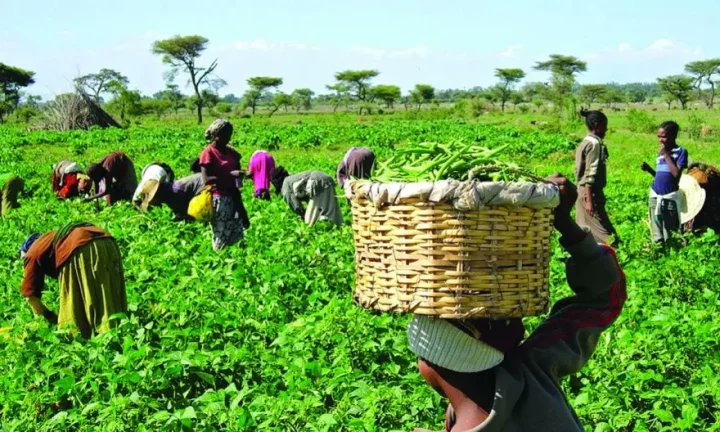
“Poverty persists due to weak performance of the real sector (a shrunken industrial sector and a slow growth in agriculture),” the financial advisory firm said.
‘HOW STAGNATION DROVE POVERTY’
Quartus Economics said Nigeria’s current poverty levels are a result of a prolonged economic downturn before the recent recovery.
“This decline, along with the sharp drop in real incomes, is the true cause of the country’s poverty burden today,” the report said.
The firm also warned that headline growth figures mask deeper structural issues.
“During the first 48 months of the decade, Nigeria’s economy expanded only 0.97%,” the report noted
“Yet, this headline growth neatly conceals the deep descent in industries across the economy.”
Quartus said sectoral performance does not balance out in reality the way it might on paper, adding that gains, declines, and stagnation do not simply cancel each other out.
“Gains in growing sectors of the economy (even when they are large) do not compensate for losses in stagnant or declining industries,” the report stated.
The advisory firm further noted that the real sector, “where the vast majority of Nigeria’s working population is employed, groaned in pain as factories got converted to warehouses, and jobs were exported to origin countries of Nigeria’s growing imports basket”.
‘NIGERIA MUST SHIFT FROM RESOURCE-LED GROWTH’
The report said Nigeria can no longer depend on extractive or government-led expansion to reduce poverty.
“With an estimated population of 237.5 million people (December 2025), Nigeria already crossed the resource-prosperity threshold and can no longer be sustained or expected to reduce poverty through resource-led or public-sector driven growth alone,” Quartus said.
The advisory firm said scaling production is now unavoidable.
“To address poverty, given its population size, Nigeria is left with no option than to grow its industrial production with a focus on high-value industrial processing, light manufacturing, and those extractive activities that feed and support industrial production,” the organisation said.
Quartus warned that failure to do so would stall progress, noting that without “substantial growth in the productive base, the fight against poverty could remain at the level of mere policies and formal speech”.
‘BORROWING, SPENDING CRITICAL TO RECOVERY’
On fiscal policy, the report said government intervention remains essential, particularly in stimulating demand.
“Government across levels must stimulate demand through a mix of strategic long-term foundational capital investment and interventions with more immediate effects,” Quartus said.
The report said borrowing may also be required.
“Faced with shrunken fiscal space (especially due to legacy debt, payment commitments on ongoing major infrastructure projects), the federal government has little options than to engage in targeted borrowing to fund if it must continue to fulfil its obligations to its contractors,” the advisory firm said.
The report also dismissed arguments that subsidy removal reduces the need for borrowing.
“The argument against borrowing premised on PMS subsidy removal ignorantly assumes that subsidy was being paid from federal government revenues. However, subsidy payments were funded as part of the fiscal deficit (i.e. via borrowing),” Quartus said.
‘GAPS REMAIN DESPITE OPPORTUNITY FOR RECOVERY’
Highlighting improvements since 2023, the report said the path to full recovery is still long.
“For Nigeria’s political and business leadership, the challenge of true economic recovery is immense, but so is the opportunity to unlock value from the recovery and growth process,” Quartus said.
The firm stressed that success is critically hinged on fierce resolve, sincerity of purpose, and a hunger for success that stops at nothing, but national greatness and shared prosperity anchored on growth that is inclusive, substantial, and sustainable.(TheCable)
-

 Politics10 hours ago
Presidency denies withholding ₦250bn NLNG dividends from states
-
News9 hours ago
5 Security Operatives Killed As B/Haram Attacks Adamawa Communities
-
News10 hours ago
FG disagrees with World Bank over H1 124% debt servicing/revenue ratio
-
Politics10 hours ago
2027: APC unveils online portal for support groups
-
Metro10 hours ago
Kidnapped Catholic Priest, three others rescued in Benue
-
News9 hours ago
Nnamdi Kanu’s Family Accuses UK Of Failing To Protect Its Citizen, Demands Action To Secure His Freedom
-
Politics9 hours ago
AbdulRazaq commends Wike’s inclusion in Presidential Campaign Council
-
Politics9 hours ago
Buhari Saw Tinubu As ‘Bad News’, Resisted His Presidency – Baba-Ahmed