Politics
Senate passes Electoral Act amendment bill to end conflicting court rulings in pre-election cases

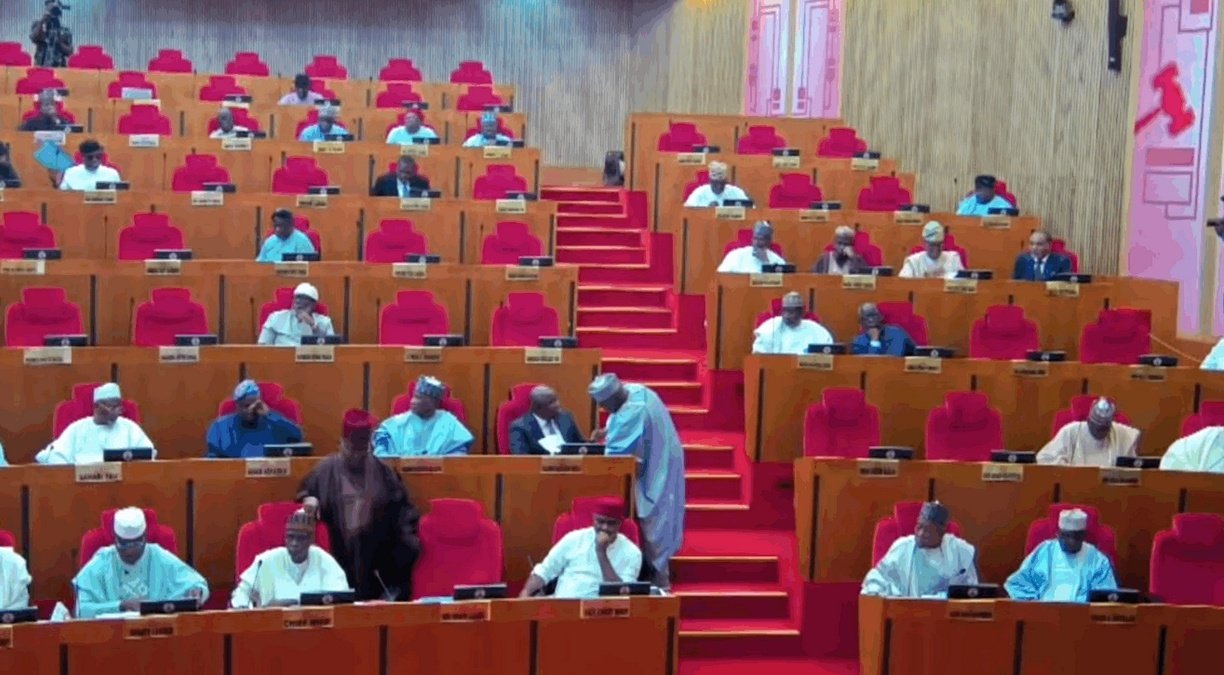
The senate has passed an amendment to the Electoral Act, 2026 seeking to provide definitive jurisdiction for pre-election matters and eliminate conflicting court rulings arising from candidate nomination disputes.
The bill, sponsored by Simon Lalong, senator representing Plateau south, and chairman of the senate committee on electoral matters, scaled second and third readings on Thursday.
The legislation seeks to curb “forum shopping”, a practice where litigants file cases in multiple courts across different states to obtain favourable rulings on the same internal party disputes.
BILL SEEKS TO END CONFLICTING COURT RULINGS

The amendment designates specific courts to handle pre-election matters in a bid to prevent contradictory judgments from courts of coordinate jurisdiction.
It also seeks to streamline the resolution of disputes arising from party primaries and ensure that the legal status of candidates is settled before general election.
Lawmakers said the amendment would reinforce timelines for the Independent National Electoral Commission (INEC) to finalise candidate lists and create greater stability for election planning.
The amendment marks the first major adjustment to the Electoral Act, 2026 signed into law by President Bola Tinubu on February 18.
While the 2026 Act focuses on the statutory integration of the bimodal voter accreditation system (BVAS) and electronic transmission of results, senators said judicial ambiguities surrounding pre-election suits required urgent clarification.
LALONG: UNCERTAINTY IN ELECTORAL LITIGATION THREATENS DEMOCRACY
Leading debate on the bill, Lalong said democracy depended not only on elections but also on the credibility and predictability of the legal framework preceding them.
“Democracy thrives not merely on the conduct of elections, but also on the credibility, certainty, and predictability of the legal process that precedes the post-election,” he said.
“The discrepancy of candidates and the integrity of party primaries are foundational pillars of representative democracy.
“Where the legal framework regulating the pre-election dispute is uncertain or conflicting, the entire electoral architecture becomes vulnerable to confusion, forum shopping, contradictory judgments, and unnecessary delays.”
The senator said the bill proposes amendments to section 29 of the Electoral Act and introduces a new section 29A to clearly define jurisdictional competence in pre-election matters.
He said the amendment to section 29(5) would allow aspirants to institute actions either in the federal capital territory or in the jurisdiction where the cause of action arose.
“This amendment is both practical and equitable,” he said.
“It reduces hardship on litigants, improves access to justice and aligns electoral adjudication with territorial realities surrounding political primaries and nomination processes.”
Lalong said the proposed section 29A would establish a jurisdictional framework under which pre-election matters relating to national assembly, governorship and state assembly elections would originate at the federal high court, with appeals going to the court of appeal.
He added that disputes relating to presidential and vice-presidential elections would originate at the court of appeal, with appeals proceeding directly to the supreme court.
“Mr. President, this proposal is not arbitrary,” he said.
“It is rooted firmly in constitutional logic, judicial efficiency, and the drafting of hierarchy of courts.”
Lalong said the bill would also eliminate the “dangerous practice” of litigants filing multiple suits in different judicial divisions in search of favourable orders.
“Such practices erode public confidence in the judiciary and undermine electoral stability,” he said.
“By expressly providing that no court shall entertain pre-election matters except in accordance with the proposed section 29A, this amendment introduces certainty and procedural discipline into electoral adjudication.”
SENATORS BACK PROPOSAL
Mohammed Monguno, senate chief whip and senator representing Borno north, said the amendment would address abuse of judicial process in election matters.
“This amendment is apt and germane. This bill seeks to nip in the bud the ugly scenario of forum shopping whereby litigants file election matters at their will in different jurisdictions in order to seek for favourable orders in their favour,” Monguno said.
He said the bill would discourage conduct that undermines public confidence in the judiciary.
Ekong Sampson, senator representing Akwa Ibom south, said the bill raises critical issues about the sanctity of the electoral process and the role of the judiciary in democracy.
“So much has been said about the dangers of forum shopping, where litigants explore a space that favours them, to find suits that will favour them. This is dangerous to democracy. This is dangerous to our political space,” he said.
Sampson said the legislation encouraged broader national conversations on fairness and democratic participation.
Adams Oshiomhole, senator representing Edo north, also backed the amendment, saying it would help reduce prolonged litigation over candidate nominations.
“I’d like to lend my support to this proposed amendment. I’m very clear it does not in any way violate the constitution of Nigeria and these objectives are also very clear and unambiguous,” he said.
The bill was earlier passed in the house of representatives on Thursday.(TheCable)
-

 Politics18 hours ago
2027: Northern govs pledge total support for Tinubu
-
Business21 hours ago
Petrol: Transporters raise fares, commuters groan
-
Metro21 hours ago
Man Drowned Trying To Rescue Suspect On Suicide Mission
-
Opinion18 hours ago
Nigeria’s jobless growth: The 800m job deficit warning
-
Politics18 hours ago
APC’s internal contradictions scare me more than Atiku, Obi – Shettima
-
News18 hours ago
How my mother was kidnapped over $2.4bn subsidy fraud — Okonjo-Iweala
-
Opinion21 hours ago
MKO: The story of an unlikely hero of democracy
-
Metro18 hours ago
Gunmen kill two policemen, set station, operation van ablaze in Abia