News
Is Tinubu Changing Security Architecture?

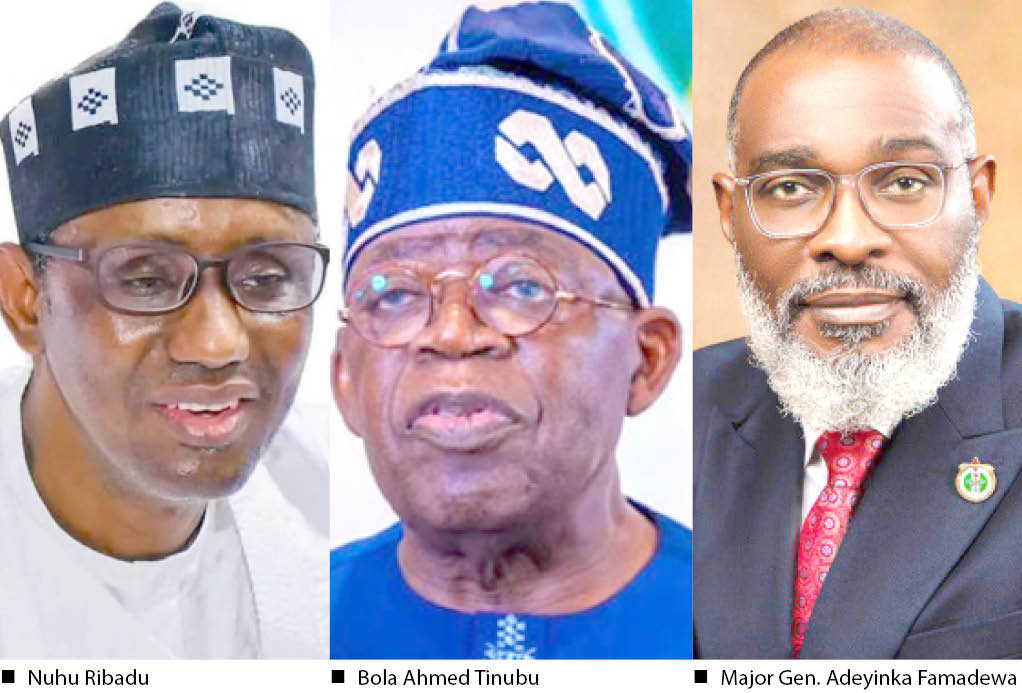
The appointment of Adeyinka Famadewa, a retired major-general, as Special Adviser on Homeland Security, has sparked debate over a new dynamic of Nigeria’s security architecture under the President Bola Ahmed Tinubu administration.
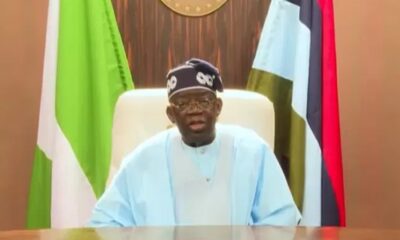
Tinubu, who is currently outside the country, announced the appointment through a circular on Monday signed by the Secretary to the Government of the Federation, George Akume and issued by the Permanent Secretary, General Services Office, Ibrahim Kana.
According to Akume, the appointment underscored the commitment of Tinubu’s administration to strengthening internal security coordination, enhancing intelligence-driven operations, and deepening inter-agency collaboration in addressing emerging security threats across the country.
Daily Trust reports that Nigeria has in recent times witnessed growing security challenges with several soldiers, policemen and other security agents paying the supreme price while sophisticated security equipment was also burnt in the process.

While some Nigerians opined that the president’s decision was in the right direction, others said the appointment has a political undertone and could be a subtle move to whittle down the powers of the National Security Adviser, Nuhu Ribadu.
Two retired Generals gave different perspectives as to why President Tinubu created the office of the Special Adviser on Homeland Security.
“I don’t think he will remove Ribadu. I believe he is trying to solidify the foundation for the state police. He will use him (the new adviser) and the Inspector-General of Police (IGP) to decentralise the police,” one of the Generals told Daily Trust.
The other General said, “Ribadu won’t go immediately. He coordinates the nation’s intelligence architecture and the General will handle internal security.
“However, going by the tribal politics seen since the present administration came to power, I won’t be surprised if Ribadu is sidelined. Maybe for the votes of the North East, he might still be relevant. However, nobody should tell me that this appointment is based on merit. What merit, really?”
A security expert, who does not want to be named, said there might be a problem.
According to him, “There are overlapping functions, no doubt about that. In the United States, the two are separated – the NSA being an advisor, and the Homeland Security Secretary being our equivalent of a minister.
“But for Ribadu and this man to be both advisers, something is really wrong somewhere. Ribadu may not be enjoying Tinubu’s trust and confidence anymore,” he said. The source said the outlook was not in favour of Ribadu.
“This was how Tinubu gradually frustrated Wale Edun, until his (Edun’s) exit. First, all of Edun’s important and sensitive duties were given to a minister of state…Edun felt more and more humiliated the longer he stayed. He was later sacked. Ribadu may hang on to give the impression that all is well. Or his entitlements may not be tampered with, but the real power may have departed elsewhere,” he said.

Who is Famadewa?
Famadewa is a decorated retired major-general with over three decades of military and intelligence service spanning national security strategy, intelligence fusion, counter-terrorism operations, and international security diplomacy.
He served as Principal General Staff Officer to the former National Security Adviser at the Office of the National Security Adviser (ONSA), Maj-Gen. Babagana Monguno from 2015 to 2021.
During his time at ONSA, he spearheaded the establishment of the Intelligence Fusion Centre (IFC), creating an integrated multi-agency intelligence platform that brought together the Defence Intelligence Agency (DIA), National Intelligence Agency (NIA), Department of State Services (DSS), the Nigeria Police Force, and the Armed Forces to improve national threat assessment and strategic response coordination.
Following his retirement from active military service, Famadewa served as Senior Research Fellow at the Nigerian Army Resource Centre, Abuja, where he continued to provide strategic thought leadership on policing, civil-security cooperation, and national security reform.
His scholarly contributions include the widely acclaimed monograph titled “Policing and National Security in Nigeria,” which offers practical frameworks for strengthening civil-security collaboration.
Ribadu, Famadewa can work together – Retired military officers
Meanwhile, in separate interviews with Daily Trust, Maj-Gen. Elvis Njoku (rtd) and Maj Bashir Galma (rtd) explained that even though there is a thin line between the duo’s responsibilities, they can still work together and get the desired results for the country and the President.
Gen. Njoku said, while the NSA advises the President in a wider capacity, Famadewa would advise him directly.
He said, “Homeland is the Ministry of Interior, you can check again. He is a Special Adviser to the President. That is what it is; there is no confusion about it.
“National Security Adviser is different; this is a Special Adviser, just like other Special Advisers, directly to the President. Their functions could overlap. This one is advisory. He’s just advising the President, just like we have other Special Advisers. What are their jobs? The SAs are just making their work directly to the President, not to the world or to Nigeria.
“NSA also advises the President in a wider capacity. This one is personal to the President.
“For instance, I’m sure you know Bayo Onanuga is the Special Adviser on Information and Strategy. Does it mean that we don’t have the Minister of Information?
“The appointment is just to add to the wealth of knowledge and clarity for the President. The President can reach quickly. I don’t think anybody is usurping another person’s power. There are new things everywhere. Change is constant. Things must not be done as they used to be. What happened in 1975 is not what is happening now; change is constant and we must be ready for change.
“Absolutely, there will be no clash between the two of them; rather, it will be a beautiful mix of relationships. They will be working together. You know Famadewa worked with Monguno almost five, six years ago. He has a wealth of experience. Is it not good to have more people in this type of place?
“The media should be campaigning for bringing more retired generals, the people that had given their best in nation-building through so many other means. So many Generals have a lot on their heads on what to do, but we just leave them like that; we must bring them on board. That’s why I say change is a constant thing.”
On his part, Maj. Galma said the NSA, being an officer from a paramilitary formation, needs both serving and retired soldiers around him.
He said, “This appointment made by President Tinubu is the right way to go, because I’m one of those who have been advocating for somebody with military experience who is going to be very close to the president to answer some professional questions regarding military operations.
“General Famadewa is a good idea, but it depends on the assignment, which may clash. Though Ribadu came from a paramilitary formation, being a policeman before, he needs these military people around him.
“But for somebody who is directly under the president, with military experience, with the rank of a major-general, I think it is a very good idea.”
Like US, like Nigeria?
Some Nigerians wondered why the Homeland Security Office was created when there is a Ministry of Interior, ONSA, among others, saying this is the first time such an office is being created.
They argued that if Nigeria must copy other countries, it must copy rightly.
Silas Omale, a retired officer of the Nigeria Security and Civil Defence Corps (NSCDC), in an interview with our correspondent, cautioned the federal government not to create another “conduit pipe” for taxpayers’ commonwealth.
He said, “If at all we want to borrow some things from other countries, it is important we copy them rightly. I pray this is not another office that will ‘swallow’ more of the taxes we’re paying.”
Checks showed that homeland security in the U.S, formally known as the Department of Homeland Security (DHS), is saddled with the responsibility of protecting the country from internal threats. The DHS was created in 2002 after 9/11, a coordinated series of terrorist attacks perpetrated by al-Qaeda against the United States in 2001.
The DHS was broken into five main missions, which include counter-terrorism and security threats; border security and immigration; cybersecurity; disaster prevention and response, as well as enforcing trade and customs laws.
On the other hand, the National Security Adviser serves as the chief adviser to the US President on national security, foreign policy and military matters. The NSA, officially known as the Assistant to the President for National Security Affairs, serves on the National Security Council and is assisted by officials who produce research, briefings and intelligence reports.
The NSA plays a critical role in the US’ National Security Council, which advises and assists the President on national security and foreign policy issues. In May 2025, President Donald Trump removed Mike Waltz as NSA and assigned Secretary of State Marco Rubio to take over the role in the interim.
(Daily trust)
-

 Metro10 hours ago
Man Held Over Undeclared $265,000 At Kano Airport
-
News10 hours ago
30 states’ debt outpaces half their annual revenue
-
Metro10 hours ago
Abuja motorists battle cattle on city roads
-
Metro4 hours ago
US death row inmate survives execution after two lethal injections
-
News10 hours ago
Reforms over, we’ve laid foundation for lasting prosperity — Tinubu
-
Social Media News4 hours ago
WhatsApp introduces parental controls for teens
-
News9 hours ago
Tinubu Signs Bill Extending 2025 Budget Implementation To Dec 2026
-
Politics9 hours ago
Gombe PDP Suspends Pantami’s Challengers