Business
Emergency empowerment programmes flood Nigeria ahead of 2027

…Huge campaign spends create grounds for vote-buying
…CBN, NESG warn of inflation, economic instability
Nigeria’s 2027 election season has entered a new phase, with political parties officially commencing campaigns on August 19 and politicians stepping up programmes that observers say could blur the line between empowerment, political mobilisation and vote-buying.

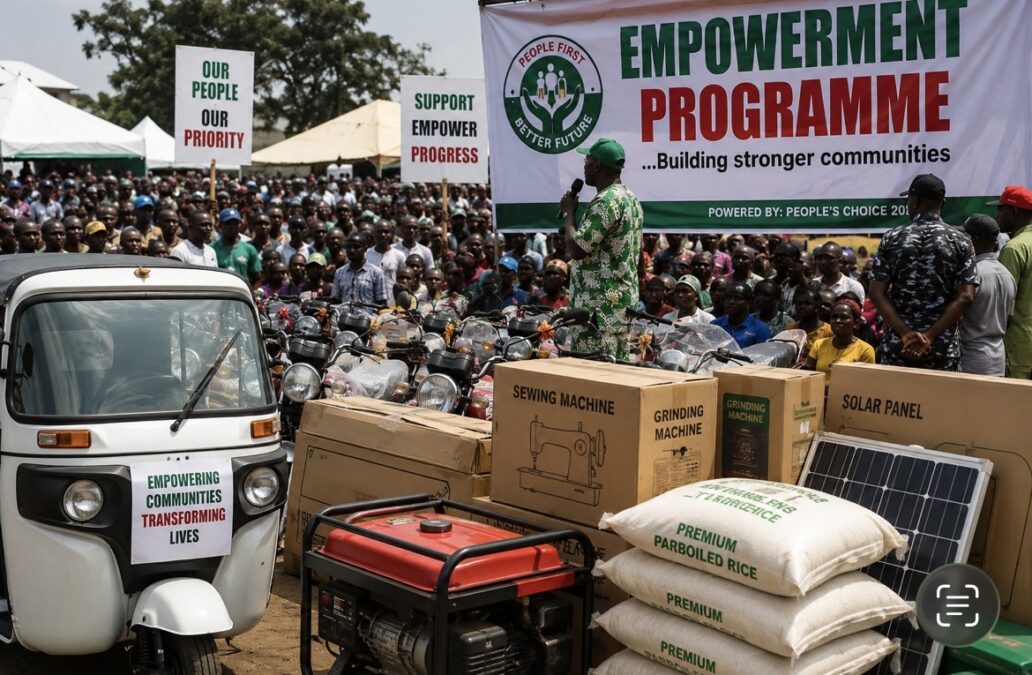
Across states and local government areas, politicians have in recent months rolled out a growing number of empowerment programmes, distributing cash, vehicles, tricycles, sewing machines, grinding machines, food items and other materials to constituents.
While such interventions are often presented as efforts to alleviate economic hardship and support livelihoods, observers say the timing and frequency of some programmes raise questions about their underlying political objectives.
The concern is heightened by the significant increase in the amount candidates are legally permitted to spend during the election cycle.
Under Section 92 of the Electoral Act 2026, the spending limit for presidential candidates has risen from N5 billion to N10 billion. The limit for governorship candidates increased from N1 billion to N3 billion, while senatorial candidates can spend up to N500 million, compared with N100 million previously.
For House of Representatives candidates, the limit rose from N70 million to N250 million, while State House of Assembly candidates can spend up to N100 million, compared with N30 million.
The limit for Area Council candidates increased from N30 million to N60 million, while councillors can spend up to N10 million, against the previous N5 million.
With the formal campaign season now underway, observers fear that the increased spending space, combined with widespread economic hardship, could create fertile ground for vote-buying.
Empowerment or electoral mobilisation?
The distinction between genuine empowerment and political inducement is becoming increasingly difficult to ignore.
In several communities, politicians have appeared at events where beneficiaries receive equipment or cash in ceremonies that also serve as opportunities for political mobilisation.
Some programmes provide assets that could genuinely help beneficiaries establish businesses. Others involve the distribution of items with limited long-term economic value.
The concern, according to observers, is that the immediate benefits offered to economically vulnerable citizens can create an informal political transaction: assistance today in exchange for electoral loyalty tomorrow.
This is particularly significant in an economy where millions of Nigerians are struggling with declining purchasing power.
For citizens facing rising food, transportation and energy costs, even modest cash transfers or household items can provide immediate relief.
That vulnerability, observers say, makes politically sponsored empowerment programmes potentially effective instruments of vote-buying.
The issue is therefore not whether politicians should support their constituents. It is whether public resources and political programmes are being deployed to create sustainable economic opportunities or to influence voters ahead of the election.
Bigger campaign budgets, bigger risks
The increase in campaign spending limits comes at a delicate moment for Nigeria’s economy.
The country is still recovering from the effects of major economic reforms that have raised costs for households and businesses.
Against this backdrop, economists are concerned that a significant increase in government and political spending could inject additional liquidity into the economy without a corresponding increase in the supply of goods and services.
The Central Bank of Nigeria had earlier raised the alarm.
At its 304th meeting held on February 23 and 24, 2026, the Monetary Policy Committee (MPC) reduced the Monetary Policy Rate by 50 basis points from 27 percent to 26.5 percent while retaining other key monetary parameters.
Olayemi Cardoso, CBN governor, warned in the MPC communiqué that election-related fiscal spending could threaten the inflation outlook despite the moderation in prices.
Muhammad Abdullahi, CBN deputy governor for Economic Policy, also identified election spending as a major risk.
He said, “As political activities intensify ahead of the 2027 elections, increased fiscal injections and consumption spending could elevate demand-side inflation.”
Abdullahi added that “the fiscal deficit has already increased significantly, and election-related spending is likely to exacerbate this trend in 2026 and early 2027.”
According to him, stronger fiscal-monetary coordination would be needed to manage the liquidity impact of rising government spending.
Warning beyond inflation
The Nigerian Economic Summit Group has also warned that the political season could complicate efforts to consolidate Nigeria’s economic recovery.
In its second-half 2026 economic outlook, the policy think tank cautioned that escalating pre-election spending could place severe pressure on fiscal discipline, heighten inflation, undermine investor confidence and stall the implementation of structural reforms required to sustain medium-term growth.
The concern goes beyond the amount of money politicians spend on campaigns.
If governments begin increasing recurrent expenditure, transfers and politically driven interventions while reducing attention to productive investment, the economy could lose momentum.
Businesses may also face higher borrowing costs as government borrowing rises, while investors could become more cautious if they perceive the election period as a period of fiscal uncertainty.
Nigerians need jobs, not election handouts
The debate over empowerment programmes comes down to what happens after the cameras leave.
A sewing machine can help someone establish a tailoring business. A tricycle can provide an income. A cash grant can help a small trader restock.
But the broader economic impact is limited if such programmes remain isolated political interventions rather than part of a coherent strategy for employment creation, skills development, access to finance and business expansion.
The billions expected to circulate during the election period could have a much larger economic impact if directed towards productive enterprises, infrastructure and services that create jobs beyond the election cycle.
Instead, observers fear that politicians may prioritise programmes that generate immediate political visibility over investments whose benefits may take years to materialise.
The politics of economic hardship
The timing is particularly significant. As political parties campaign for votes, millions of Nigerians are making daily calculations about food, rent, transport, school fees and electricity.
This creates a powerful political incentive for candidates to offer immediate relief.
But what looks like empowerment to a struggling household could become a political liability for the country if it develops into systematic vote-buying.
The danger is that citizens receive short-term benefits while the structural problems responsible for their hardship remain unresolved.
Nigeria could therefore find itself in a paradox: politicians spending more money than ever to win elections, while citizens remain poorer and the economy becomes more vulnerable to inflation and fiscal pressure.
The challenge for regulators, civil society and voters is to distinguish genuine economic empowerment from political inducement.
For politicians, the bigger test should be whether the money being spent ahead of 2027 leaves behind jobs, productive businesses and stronger communities, rather than simply larger crowds at campaign rallies.
Otherwise, Nigeria risks paying twice: first through public resources spent on political mobilisation, and again through the inflation and economic instability that could follow. (BusinessDay)
-

 Metro23 hours ago
Nigerian man, Adebayo arrested in Canada after exposing self to three victims
-
News6 hours ago
Experts caution as IMF offers fresh advice on subsidy
-
Politics6 hours ago
2027: Nigerians Won’t Renew A Mandate Of Hardship – Atiku Tells Tinubu
-
Sports6 hours ago
CAF Hands NFF, Other Member Federations $175,000 Boost In Annual Subvention
-
Politics6 hours ago
Stop Eyeing A Position That Is Not Available – Akpabio Warns APC Govs
-
Politics6 hours ago
2027: We know how to stop Tinubu from getting second term - Momodu
-
Politics6 hours ago
No one owns voters – Obidients tell Wike
-
News6 hours ago
Many soldiers feared killed as terrorists attack military post in Borno