Opinion
The elephant in the room: Atiku’s pro-poor subsidy proposal and matters arising


There are some political arguments that refuse to die because the problem they address refuses to disappear. In Nigeria, few debates fit that description better than the petroleum subsidy question.
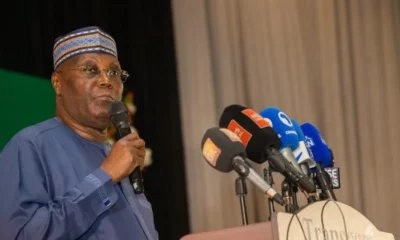
Three years after President Bola Ahmed Tinubu announced the removal of petrol subsidy in his inaugural address, former Vice President Atiku Abubakar has reopened the argument with a proposition that is as politically provocative as it is economically consequential: if elected president in 2027, he would restore a form of petrol subsidy to shield Nigerians from the crushing effects of high fuel prices.
Atiku’s intervention could easily be dismissed as election-season politics, but in doing so would miss the larger point. The subsidy debate has returned because the economic pain that followed its removal has remained stubbornly real.
Reuters reported this month that millions of Nigerians continue to struggle with sharply higher costs of food, transportation, housing and energy, even as investors increasingly applaud the macroeconomic reforms undertaken by the Tinubu administration. That contradiction is the elephant in the room.

The question is no longer simply whether subsidy removal was economically necessary. The more difficult question is whether the savings and macroeconomic benefits generated by the reform have translated sufficiently into improved welfare for the ordinary Nigerian.
Atiku is betting that they have not – His proposal, however, deserves more sophisticated scrutiny than the simplistic “Atiku wants subsidy back” narrative suggests. The model being advanced by his camp reportedly seeks to move government support away from imported refined petroleum products and toward domestic refining.
Under the proposed arrangement, qualifying local refineries would receive crude at subsidised rates, with the intervention capped, budgeted and tied to verified domestic production and lower consumer prices.
That distinction matters.
Nigeria’s old subsidy regime became synonymous with opaque accounting, import dependence, questionable claims, arbitrage and enormous fiscal leakage. It was a system in which the government effectively absorbed part of the cost of petrol while the country remained dangerously dependent on imported refined products despite being a major crude-oil producer.
A return to that model would be difficult to defend, but a production-linked intervention designed to support domestic refining is a different proposition. It raises another question: can Nigeria deploy a targeted subsidy without recreating the very distortions that made the old regime unsustainable?
That is where Atiku’s proposal must be tested. The pain beneath the numbers is the strongest argument against an uncritical return to subsidy is fiscal. The PBAT-led administration insists that subsidy removal was indispensable to preventing fiscal collapse.
President Tinubu said in May that the reform saved Nigeria from imminent bankruptcy, while Finance Minister Taiwo Oyedele reiterated in August that the wider economic reforms helped stabilise public finances, strengthen reserves and attract investment.
Those are not trivial achievements.
Nigeria had spent years borrowing to finance consumption while struggling to fund infrastructure, education, healthcare and security. Subsidising petrol for everybody, rich and poor alike, was an increasingly expensive way of providing social protection.
Yet there is an uncomfortable counterpoint – The government itself has acknowledged that much of the fiscal space created by subsidy removal has been absorbed by higher debt-servicing obligations and increased government spending.
For the Nigerian who now pays considerably more to transport a child to school, move goods to market or commute to work, the distinction between “subsidy savings” and “fiscal sustainability” can seem abstract.
This is the political opening Atiku has identified – His argument is essentially that Nigerians were asked to endure extraordinary pain in exchange for a better economic future, but that future has not arrived quickly enough or visibly enough for the average household.
There is evidence that the frustration is real. Reuters reported in August that petrol prices are roughly six times higher than before the subsidy was removed, while the cost of staple food has risen dramatically.
The same report noted that the World Bank estimated that just over half of Nigeria’s population was living in poverty in 2025, compared with about 42 percent in 2022.
This is the constituency Atiku is speaking to. Is subsidy really the answer?
Here lies the first major matter arising. The fact that subsidy removal created hardship does not automatically prove that subsidy restoration is the solution.
Nigeria’s economic problem is deeper than the price of petrol – A subsidy can reduce the pump price without necessarily reducing the structural cost of living. If electricity remains unreliable, manufacturers will continue to depend on diesel and petrol generators. If roads remain inefficient, transportation costs will remain elevated. If food production is constrained by insecurity, logistics and high input costs, cheaper petrol alone will not put affordable food on Nigerian tables.
There is also the danger of making government once again responsible for guaranteeing an artificially low price while the underlying production system remains inefficient. That would be subsidy by another name, and Nigeria has been there before.
The more credible version of Atiku’s argument is therefore not “bring back the old subsidy.” It is: use targeted public intervention to make domestic petroleum production cheaper, more competitive and ultimately more beneficial to consumers.
That is a proposition worth debating – The Dangote question? Nigeria is also entering a different petroleum era. The emergence of large-scale domestic refining changes the economics of the subsidy conversation. The Dangote refinery, alongside other refining investments, offers Nigeria an opportunity to reduce its historic dependence on imported refined petroleum.
Atiku’s proposal therefore arrives at a moment when the country has the beginnings of the infrastructure required for a different kind of intervention: one tied to domestic production rather than import dependency.
The critical question is how such a system would be administered.
Who qualifies?
How is the volume of crude allocated determined?
Who verifies production?
How is the subsidy calculated?
What prevents crude supplied at a preferential rate from being diverted, exported or converted into another form of arbitrage?
Then most importantly, how does government ensure that the benefit reaches consumers rather than becoming another transfer to politically connected businesses?
These questions cannot be answered by campaign rhetoric.
The Tinubu administration also has a responsibility. Yet the government should resist the temptation to answer Atiku simply by declaring subsidy restoration irresponsible.
That response would be inadequate.
The administration has made a compelling macroeconomic case for its reforms. In the long run, economics is not ultimately judged only by balance sheets, reserves or investor sentiment. It is also judged by whether households can live with dignity.
The government cannot indefinitely ask Nigerians to celebrate improved macroeconomic indicators, while telling them to be patient about their daily realities.
Indeed, the emerging contradiction is striking: investors are increasingly optimistic about Nigeria, while ordinary citizens remain deeply pessimistic about their economic circumstances. Reuters recently reported that nearly 80 percent of Nigerians surveyed by SBM Intelligence believed the country was moving in the wrong direction, with economic hardship and insecurity among their dominant concerns.
That gap between macroeconomic confidence and household experience is politically dangerous.
The real test for Atiku, as he deserves credit for putting the welfare question back at the centre of the economic conversation. He must do more than promise cheaper petrol. If his proposal is genuinely pro-poor, he should publish the numbers.
How much would the intervention cost annually?
What is the proposed funding source?
What is the maximum subsidy per litre?
What happens when crude prices rise?
What happens when they fall?
How long would the intervention last?
What measurable poverty-reduction outcomes would accompany it?
Then what independent institution would audit the programme?
A serious presidential economic proposal should be able to survive these questions.
The opposition candidate must also confront his own political history and the broader Nigerian tendency to promise relief without sufficiently explaining the fiscal consequences.
Subsidy politics is attractive because the benefit is immediate and visible, while the cost is dispersed and often deferred.
That is precisely why Nigerians need more than political slogans.
Beyond the subsidy binary, perhaps the greatest value of Atiku’s intervention is that it challenges Nigeria to escape a false binary.
The choice is not necessarily between unlimited subsidy and complete abandonment of government intervention. There is a third possibility: targeted, transparent and temporary intervention that supports production, protects vulnerable households and accelerates the transition to a genuinely competitive energy market.
Government could, for instance, concentrate support on public transportation, mass transit, food logistics, critical productive sectors and vulnerable households rather than subsidising every litre consumed by every Nigerian.
It could strengthen domestic refining without creating permanent dependence on government-controlled pricing.
It could invest subsidy savings visibly in healthcare, education, mass transit, security and productive infrastructure.
And it could establish an independent public dashboard showing exactly what subsidy reform has saved, where the money has gone and what Nigerians have received in return.
That would answer Atiku more effectively than political denunciations. The elephant remains. Ultimately, the return of the subsidy debate is less a referendum on Atiku Abubakar than a verdict on the unfinished business of economic reform.
Tinubu may be right that Nigeria could not continue indefinitely with the old subsidy regime. Atiku may equally be right that government cannot ignore the social consequences of the transition.
Both propositions can be true.
The real challenge is to build an economy in which Nigerians do not need perpetual petrol subsidies to survive.
That requires cheaper energy, functioning refineries, reliable electricity, efficient transportation, food security, productive jobs, stronger social protection and disciplined public spending. Until those pillars are firmly established, the subsidy question will continue to haunt every Nigerian administration. The elephant in the room, therefore, is not simply whether subsidy should return.
In a nutshell, it is whether Nigeria can finally convert the enormous sacrifices demanded of its citizens into an economy in which prosperity is no longer a promise deferred.
Atiku has opened that conversation.
Now, both the opposition and the government owe Nigerians something more valuable than campaign rhetoric: the numbers, the strategy and the evidence that their respective visions can actually deliver a better life.
Ayoola Ajanaku is a communications and advocacy specialist based in Lagos, Nigeria
-

 News8 hours ago
Experts caution as IMF offers fresh advice on subsidy
-
Politics8 hours ago
2027: Nigerians Won’t Renew A Mandate Of Hardship – Atiku Tells Tinubu
-
Politics8 hours ago
Stop Eyeing A Position That Is Not Available – Akpabio Warns APC Govs
-
Sports8 hours ago
CAF Hands NFF, Other Member Federations $175,000 Boost In Annual Subvention
-
News8 hours ago
Many soldiers feared killed as terrorists attack military post in Borno
-
Politics8 hours ago
2027: We know how to stop Tinubu from getting second term - Momodu
-
Politics8 hours ago
No one owns voters – Obidients tell Wike
-
Politics8 hours ago
Nigerians better off under Tinubu – APC spokesman insists