Business
Petrol price may hit N1,400/litre as Dangote Refinery suspends loading

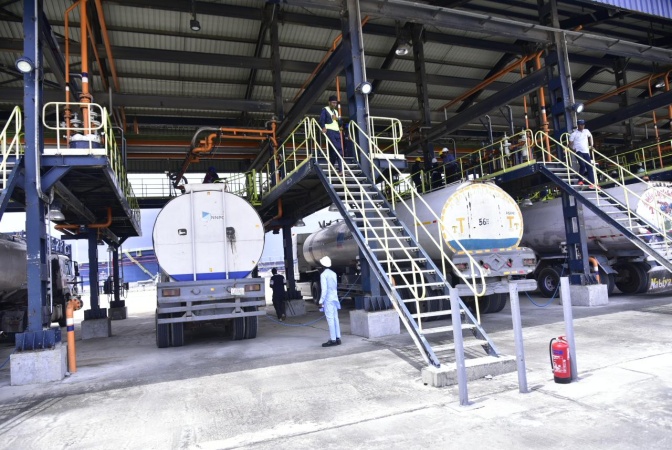
Petrol prices in Nigeria could rise to about N1,400 per litre this week as marketers await a possible repricing of Premium Motor Spirit (PMS) by the Dangote Refinery amid rising crude oil prices, supply constraints and logistics challenges.
Multiple industry sources said petrol loading had been halted at the refinery, raising expectations that a fresh ex-depot price adjustment could be announced as early as today.
The development follows a recent surge in international crude oil prices linked to escalating tensions in the Middle East, which have increased feedstock costs for refiners and tightened supply across global energy markets.
With pump prices already averaging N1,200 in some parts of the country, marketers said the price may hit N1,400 per litre as crude oil races towards $100 per barrel.

The Petroleum Products Retail Outlets Owners Association of Nigeria (PETROAN) said none of its members was able to load petrol from the refinery on Sunday.
The National President of PETROAN, Dr Billy Gillis-Harry, confirmed the situation, saying marketers are waiting for clarity on the refinery’s next pricing decision.
Gillis-Harry said: “Today we didn’t load and we are not sure what will happen tomorrow. It is because of the possibilities around crude oil prices. The price of crude is not stable; it can go up or come down. Until the crisis in the Middle East de-escalates, it is difficult to predict what will happen.”
Sources at the Major Energy Marketers Association of Nigeria (MEMAN) also told The Guardian that loading activities had been suspended at the facility while industry players await a possible price revision.
Similarly, the Nigerian Association of Road Transport Owners (NARTO) confirmed that tanker drivers were not loading products from the refinery, noting that only a limited number of marketers, including MRS and NNPC Retail, were reportedly allowed to lift products.
An industry player, Jide Pratt, said the expected repricing may reflect prevailing international crude oil prices rather than the refinery’s previous ex-depot benchmarks.
He noted that the refinery has faced challenges sourcing sufficient crude locally, forcing it to rely on imported supplies.
“This shows the risk of having a single dominant supply source for the market,” he said.
However, the Dangote Group dismissed claims that loading had been halted.
The Group’s Chief Corporate Communications Officer, Anthony Chiejina, described the report as “nonsense”, insisting that product pricing would continue to reflect prevailing international market conditions.
RETAIL market checks conducted by The Guardian across major filling stations in Lagos showed that PMS continues to sell above the N1,000 per litre threshold, with pump prices ranging between N1,015 and N1,057 per litre, depending on location and supply pathway.
At Mobil filling station in Idowu Egba along LASU–Isheri Road in Lagos, petrol was sold at N1,015 per litre, while Petrocam station dispensed fuel at N1,050 per litre.
Similarly, MRS filling stations sold PMS between N1,030 and N1,040 per litre in parts of Alimosho, while Mobil outlets at Alaguntan and Iyana Ipaja sold petrol at N1,015 and N1,057 per litre, respectively.
Other retail outlets reflected similar pricing trends. Heyden stations in Iyana Ipaja and along Zik House on the Oshodi–Abeokuta Expressway sold PMS at N1,035 per litre, while Northwest station in Onigbongbo, Maryland, dispensed the product at N1,030 per litre.
Market sources indicated that the difference between coastal marine product lifting arrangements and gantry loading operations is gradually shaping distribution pricing behaviour across the downstream petroleum supply chain.
According to data from the Major Energies Marketers Association of Nigeria, the ex-depot price of PMS in Lagos currently ranges between N940 and N1,000 per litre, reflecting cost pressures confronting marketers in sourcing and distributing the product.
The association’s latest energy bulletin showed that Nigeria’s estimated import parity price for petrol averaged about N748.46 per litre over the past 30 days, while spot market prices rose to about N910 per litre, underscoring the volatility in international petroleum trading.
For many motorists, however, these technical pricing explanations provide little immediate relief.
Commercial driver Ibrahim Lawal, who operates along the Iyana Ipaja–Oshodi corridor, said the latest price movement may compel transport operators to review fares once again.
“Fuel is now over N1,000 per litre in many stations. Every time the price changes, transport fares must go up. But passengers are already struggling,” he said.
Another motorist, Saheed Adeyemi, who frequently refuels at stations around Alimosho, lamented the growing uncertainty surrounding pump prices.
“Some stations sell for N1,030, others for N1,050, and sometimes even higher. As motorists, we now spend time driving from one station to another looking for cheaper fuel,” he said.
Recent market intelligence from MEMAN indicates that international crude benchmarks remain elevated, with Brent crude trading around $85 per barrel and Nigeria’s Bonny Light crude hovering above $83 per barrel, levels historically associated with upward pressure on refined product prices.
The Dangote Petroleum Refinery explained that crude procurement costs remain high, noting that Nigerian crude is currently trading about $3 to $6 above the Brent benchmark. When freight charges of approximately $3.50 per barrel are included, landing costs could range between $88 and $91 per barrel.
The refinery noted that crude previously landed at about $68 per barrel when domestic ex-depot pricing was closer to N774 per litre, illustrating the sensitivity of local prices to international market fluctuations.
The company also disclosed that it currently receives about five cargoes of crude monthly from the Nigerian National Petroleum Company Limited, a volume considered below the estimated 13 cargoes required monthly to sustain large-scale domestic distribution.
The supply shortfall compels additional crude procurement through international trading channels at prevailing foreign exchange market rates, further exposing the domestic market to currency volatility.
The refinery said it continues to absorb about 20 per cent of the recent cost escalation to moderate the immediate impact on consumers, although industry operators say sustained market stability may depend on improved crude supply logistics and foreign exchange predictability.
Commercial drivers operating in Lagos noted that even marginal differences of N10 to N20 per litre across stations significantly affect daily operating margins, forcing many to shuttle between outlets in search of relatively cheaper fuel.
Middle East tensions push manufacturers’ diesel bill to N620b, threaten higher airfares
THE ripple effects of the escalating tension in the Middle East have worsened Nigeria’s fragile energy system, pushing operating costs for businesses, especially manufacturers, sharply higher and threatening another round of increases in air travel fares.
Estimates by The Guardian, based on prevailing market data and the Nigerian Midstream and Downstream Petroleum Regulatory Authority (NMDPRA), show that Nigerian manufacturers and businesses may spend at least N620 billion on diesel in March, as companies increasingly rely on self-generated power amid falling electricity supply and surging global energy prices.
The development reflects a broader global shock triggered by the conflict, which has pushed commodity markets into volatility and driven up transportation costs worldwide.
Global oil prices have surged by about 21 per cent, while aviation fuel has jumped by around 87 per cent in just over a week. Liquefied natural gas (LNG), a key fuel for electricity generation and industrial production, has been hit even harder, with prices rising by more than 100 per cent.
As the war affects the Strait of Hormuz, limiting tanker traffic, freight costs have also spiked sharply. Rates for very large crude carriers (VLCC) have climbed by more than 200 per cent, while LNG carrier rates have surged by over 500 per cent, signalling growing disruption across global energy supply chains.
The surge in fuel prices is already translating into higher operating costs across Nigeria’s economy, particularly for manufacturers who depend heavily on diesel generators to compensate for unreliable electricity supply.
Currently, gas constraints have reduced Nigeria’s electricity generation by more than 40 per cent, leaving distribution companies to ration about 2,800 megawatts of electricity and forcing industries to rely even more on alternative power sources.
In January, businesses were already consuming roughly 14 million litres of diesel daily, according to industry estimates and data from NMDPRA. With diesel prices continuing to rise alongside crude oil benchmarks — from N929 per litre in late February to an average of N1,428 — The Guardian estimate shows that total spending on diesel could reach N620 billion this month, placing additional financial pressure on factories, logistics companies and small businesses.
The price of aviation fuel in Nigeria has also risen dramatically in just 10 days, climbing from N965 per litre on February 25 to about N1,785 per litre, representing an increase of nearly 85 per cent.
Given that Nigerian airlines consume approximately three million litres of aviation fuel daily, industry calculations suggest the sector may spend about N166 billion on jet fuel in March.
Without the sudden spike in prices triggered by the Middle East crisis, airlines would likely have spent about N89.7 billion on the product during the same period.
The sharp rise in aviation fuel costs is expected to translate into higher airfares in the coming weeks, as airlines attempt to pass part of the increased operational burden to passengers.
Fuel typically accounts for 40 to 50 per cent of airline operating costs in Nigeria, making the sector particularly vulnerable to sudden price movements.
Meanwhile, shipping analytics firm Kpler has shown that gasoline cargo arrivals in Nigeria fell to their lowest level in at least nine years in February.
Imports dropped to about 50,000 barrels per day, more than half the volume recorded in the previous month and nearly two-thirds lower than levels seen a year earlier.
Nigeria has historically been the largest gasoline importer in West Africa, but the decline reflects changing domestic refining dynamics following increased operations at the Dangote Refinery.
Europe remained Nigeria’s largest supply region in February, providing around 38,000 barrels per day, but the country accounted for just four per cent of Europe’s total gasoline exports, compared with 12 per cent a year earlier.
While gasoline production at the refinery fluctuated between 16 million litres per day and 32 million litres per day in 2025, NMDPRA said last month that receipts from the facility rose to 40 million litres in January, overtaking imports for the first time within the period.
The shift reflects a gradual increase in domestic production after the Dangote refinery completed a two-week maintenance programme on its crude distillation unit earlier in February.
Key gasoline-producing units at the refinery, including the naphtha hydrotreater, isomerisation unit and catalytic reformer, had previously been operating at reduced capacity following maintenance work in January.
Kpler confirmed that the refinery’s 218,000 barrels-per-day residual fluid catalytic cracker (RFCC), a major gasoline-producing unit, has now returned to about 90 per cent capacity following test runs in mid-February. The unit had been offline since December.
By late January, only one import permit, covering 300,000 tonnes, had been issued to local marketer MRS, the research firm said.
Coming after a leadership change that rattled the regulatory landscape, the limited import approvals allowed marketers to draw down from existing inventories, which had climbed to about 1.27 million tonnes in January.
Despite the drop in imports, the Dangote refinery remained the dominant participant in Nigeria’s gasoline import market in February, accounting for about 70 per cent of all arrivals, or roughly 35,000 barrels per day, the report noted.
Experts defend Dangote refinery pricing, accuse marketers of misleading public
ENERGY experts in Nigeria’s downstream petroleum sector have defended the pricing structure of the Dangote Petroleum Refinery, accusing some fuel marketers of attempting to blackmail the refinery and mislead the public over the recent increase in petrol prices.
The experts said reports suggesting that the refinery’s latest adjustment is solely responsible for the recent hike in fuel prices were misleading, noting that importers are also bringing in petrol at almost N1,000 per litre, while the refinery’s coastal price is N948 per litre and the gantry or ex-depot price stands at N995 per litre.
They stressed that public comparisons often fail to consider the differences in pricing structures and supply channels.
According to the experts, N948 per litre represents the coastal delivery price, which refers to petroleum products transported by marine vessels or barges from the refinery to depots along the coastline. By contrast, N995 per litre represents the gantry or ex-depot price paid by marketers who load petrol directly from the refinery into tanker trucks at the loading gantry for distribution across the country.
The experts explained that the two figures should not be interpreted as conflicting prices but rather as different logistics arrangements within the petroleum distribution chain.
Energy expert David Okon said the pricing adjustments were inevitable given prevailing market conditions.
According to him, Dangote Petroleum Refinery & Petrochemicals operates in a deregulated market and procures crude at international prices, which have risen sharply due to geopolitical tensions in the Middle East.
“The refinery is already absorbing part of the cost to cushion the impact of the crisis on Nigerians. We can see what is happening in other parts of the world where shortages and scarcity are being reported despite higher prices, yet the Dangote Refinery has continued to guarantee domestic supply,” he said.
Okon explained that when the refinery previously sold petrol at N774 per litre, crude oil was landing at about $68 per barrel. However, with crude now arriving at roughly $95 per barrel, the cost difference of about $27 per barrel translates to nearly N40,000 per barrel when converted to naira.
“You cannot expect a refinery to continue selling at the old rate under those circumstances. If imported products were truly cheaper, importers would still be selling at the previous prices,” he said.
He warned that without local refining capacity, Nigeria could have faced severe fuel shortages, long queues at filling stations and a resurgence of black market sales.
“Without the Dangote Refinery, many filling stations would likely shut down, queues would return across the country and black market traders would exploit the situation, hawking four-litre kegs at N20,000 or more. The refinery has effectively prevented that scenario,” he said.
Another analyst, Mohammed Ibrahim, also faulted narratives suggesting that the refinery’s pricing adjustment was responsible for worsening economic hardship in the country.
Accusing some importers of attempting to manipulate public perception, he said: “What we are seeing is nothing but deliberate blackmail by some fuel importers who feel threatened by local refining. They are twisting the pricing structure to mislead Nigerians and create unnecessary panic in the market.
“By exaggerating the refinery’s gantry price and ignoring the comparable costs of imported fuel, they are trying to make it appear as though Dangote Refinery is the cause of rising prices and economic hardship. This is a calculated attempt to protect their import businesses and undermine local refining, which is meant to reduce our dependence on imported petrol.”
Ibrahim added that such narratives were aimed at portraying the refinery as the reason Nigerians were struggling with higher petrol prices.
He stressed that petrol pricing in Nigeria is largely influenced by global crude oil prices, exchange rate fluctuations and distribution logistics, noting that these factors affect both locally refined and imported fuel in the country’s deregulated market.
Managing Director and Chief Economist at Analysts’ Data Services and Resources (ADSR) Limited, Afolabi Olowookere, said that although Nigerians expect refined products from the refinery to be significantly cheaper, prevailing market realities, such as global crude oil prices, the cost of crude supply and refining margins, make substantial price reductions unlikely in the short term.
“Therefore, improving domestic crude allocation to the refinery would strengthen supply stability and enhance the long-term benefits of local refining for the economy,” Olowookere said.
Recent conflicts in the Middle East and disruptions along key shipping lanes have tightened global oil supply, pushing crude prices past $90 per barrel, a development that directly raises the cost of both imported and locally refined petrol in Nigeria. (The Guardian)
-

 Metro22 hours ago
Man threatens to release Kano governor’s nude videos, photographs
-
Sports22 hours ago
Harry Kane crowned 2026 Ballon d’Or winner
-
World News22 hours ago
Trump hits back at Obama over Saddam ‘Cheesecake Factory’ jab
-
News22 hours ago
OPHK troops destroy ISWAP enclaves in Lake Chad, kill 16 terrorists
-
Business22 hours ago
Microsoft offers voluntary exit packages to 60,000 staff
-
Politics22 hours ago
‘He was trained in sanitation’ — Shettima says Atiku can’t govern modern economy
-
Politics21 hours ago
FACT CHECK: How Tinubu’s Image On Bread Was Edited To Depict Obi
-
Politics20 hours ago
INEC uploads voters’ register online after outcry