Business
Nigeria’s ginger export crashes from N26 billion to zero in three years

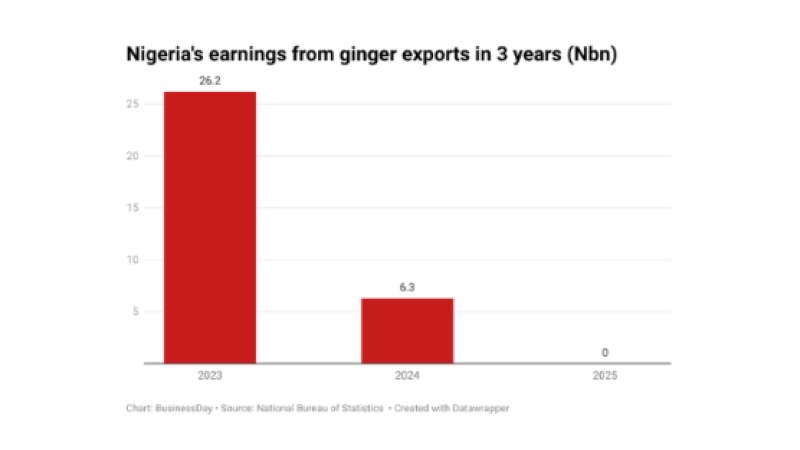
Nigeria’s non-oil export ambitions suffered a severe setback, with ginger exports collapsing to zero by the end of 2025, down from N26.2 billion three years prior. A devastating combination of a persistent fungal blight and soaring production costs has priced Nigerian ginger entirely out of the global market, forcing the country to surrender its status as a leading global agricultural supplier.
The country earned zero naira from ginger exports in 2025, down from N6.3 billion in 2024, according to the National Bureau of Statistics. This was after domestic prices surged to N15.2 million ($10,000) per ton, a 400 percent increase from the then international average of $2,000.

The price surge made exports unprofitable, discouraging exporters from shipping the commodity in 2025. The collapse in shipments marks a sharp setback for one of the country’s leading agricultural exports, diverting limited supplies to the local market where demand remains strong.
Bamidele Ayembo, managing director at 3T Impex Consulting, said that pricing is the major issue why the country recorded zero exports of ginger in 2025. He explained that the recurring blight disease outbreaks and rising input costs spiked domestic prices to unprecedented levels.
“Our prices for split dried ginger were over five times higher than the pricing at the international market, and this rendered export sales unprofitable,” he said.
“My clients in Asia were insisting on paying $2,000/ton for shipments of ginger in 2025, and I can only sell at $10,000/ton to be profitable,” he explained. “We couldn’t export at that price, and since then, we haven’t exported ginger,” he noted.
Ginger has become a top-notch cash crop in Nigeria, and it is one of the commodities focused on by the federal government to revamp the Nigerian economy and boost exports. However, the recurrent ginger blight disease, which has been present since 2023, is significantly impacting production and threatening Nigeria’s position as an exporting country.
“Our last ginger export was in early 2023 when the prices started surging gradually as diseases ravaged farms,” Abdulsalam Ahmad, chief executive officer of Triple Gee Merchant Nigeria Limited, an agricultural commodities export firm, said.
Ahmad explained that the sector is yet to recover from the recurring disease attack in 2023 and 2024, which wiped out 90 percent of farmers’ production, saying the impact has disrupted the value chains and altered the momentum in the industry.
“We cannot export ginger now. It makes sense to sell at the local market rather than export,” he noted. He says the episode underscores how disease and cost pressures continue to undermine Nigeria’s competitiveness in global agricultural trade.
Losing export status
Nigeria is the largest producer of ginger in Africa and the seventh largest exporter of the commodity globally. However, its ginger production has been under pressure, cutting output and revenue from the commodity in recent years.
The country’s ginger production was 751,473 metric tonnes in 2022, according to data from the Food and Agriculture Organisation, and plunged to 67,600 metric tonnes in 2023 when the first outbreak of the blight disease occurred, as estimated by AFEX Commodities.
Nigeria’s production recovered from a near collapse in 2023 to 159,600 metric tonnes in 2024. The figure is still far below the historic levels of over 700,000 metric tonnes.
Export earnings also collapsed within the period as scarcity drove local prices to record levels. Data from the NBS Foreign Trade report shows that ginger export revenue plunged 76 percent in 2024 from N26.2 billion in 2023 to N6.28 billion in 2024.
The 2024 figure further plunged to zero in 2025, as exporters were discouraged from exporting despite a marginal recovery in local production. The sector has suffered from a combination of issues ranging from disease outbreaks, worsening insecurity, and rising input costs.
Rising input costs
Farmers are increasingly worried as ginger seed prices spike ahead of the 2026 planting season. The high cost of ginger seeds and fertiliser, amid rising energy costs, is forcing them to scale back on production.
Florence Edwards, national president of the Ginger Growers, Processors and Marketers Association, told BusinessDay that seeds are more expensive this year, noting that many farmers are yet to recover from the losses caused by the blight disease.
Edwards explained that many ginger farmers are switching to other crops due to high production costs, while those staying in the business are scaling back production areas.
BusinessDay surveyed markets in Kaduna and found that a 100 kg bag of ginger seeds now sells for an average of N560,000.
Government must act now
Experts are urgently calling for seed subsidies, warning that without immediate support, Nigeria’s ginger production crisis could deepen in 2026.
Samaila Maigoro, CEO, Falke Industries Limited, said the prices of ginger seeds will surge further if the government fails to support farmers’ access to improved seeds for cultivation.
Ginger farmers have not fully recovered from the huge losses they recorded and do not have sufficient capital to kick- start at scale, Maigoro said, noting that they couldn’t store seeds for the next planting season due to the outbreak.
“The government must subsidise ginger seeds for farmers. Once the prices of seeds are affordable, farmers will scale production, output will increase, prices will drop, and export momentum will commence,” he added.(BusinessDay)
-

 Sports24 hours ago
Vozinha, Mbappe, Messi, Haaland Headline FIFA World Cup Dream XI
-
News23 hours ago
191m Nigerians couldn’t afford healthy diet in 2025 over high food costs – UN
-
Business23 hours ago
Dangote returns to naira sales, raises ex-depot price to N1,215
-
News24 hours ago
Bandits Abduct Over 50, Impose Levy On Sokoto Deputy Gov Community
-
News24 hours ago
Killing Of Photographer: We’ve Degraded Boko Haram’s Propaganda Machinery – Troops
-
Politics23 hours ago
2027 presidential elections: INEC ‘helpless’ as early campaigns flout Electoral Act, fairness rules
-
News19 hours ago
‘Blank Cheque For Corruption’ – Atiku Hits Tinubu Over Multi-Billion Naira Palace Allocation
-
Business22 hours ago
In Huaxin, Dangote and BUA face a rival powered by Hong Kong capital