News
Ngoshe: 2 Months After, Families Await Rescue Of Abductees

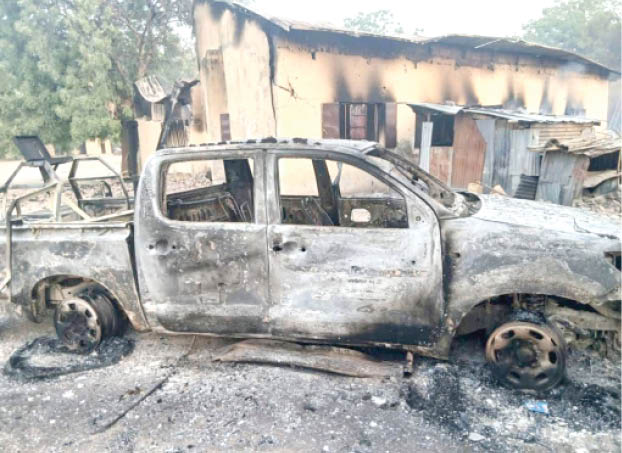
As the sun set on March 3, 2026, residents of Ngoshe village, Gwoza Local Government Area of Borno State, were startled by repeated sounds of gunfire that rattled their homes and streets.
The gunshots, fired by Boko Haram insurgents, first started at the military base about a kilometer away before spreading through the rest of the village.
Reports noted that the night attack happened during the Ramadan period when majority of the community members were breaking their fast.
The incident claimed many lives, destroyed property worth millions of naira and displaced thousands of persons, who are now taking refuge in Pulka, a town few kilometres away from Ngoshe.

After the deadly attack, the terrorists took over 400 women and children into the rocky shrubs of Mandara mountains, said to be a difficult terrain, where visibility is hazy
Two months later, surviving residents, families and relatives say they are trapped, traumatised and remain in grief as they have lost contact with their abducted loved ones.
In an interview with Weekend Trust, families of the abductees said it had been painful waiting for their return for such a long time.
“We still don’t have reliable news about our abducted family members. We only hear unfiltered news about their condition from people that escaped from captivity recently,” said a family member living in Pulka town.
Corroborating his claim, another family member, Halima Iliya, who lives in the Pulka internally displaced persons camp, said the last time she saw her daughter was on the night of the attack.
“We only hear stories of our abducted loved ones from those who escaped. It is terrifying listening to such stories.
“They live in hunger and the fear of being attacked. We learnt that some of the abductees were affected by the military airstrike on the Boko Haram location.
“We don’t know if our children are dead or alive. I am appealing to the government to do something urgent about this,” she said.
Like many other parents interviewed, Iliya said she hardly slept at night because of the terrifying stories she got from victims that escaped.
Abbas Idrissa, whose mother, Malama Zainabis, is one of those kidnapped, described the incident as tragic.
“Nothing is as tragic as waking up to see your mother taken away and there’s nothing you can do to save her. She was kidnapped alongside two of her female grandchildren.
“If I had the money I would pay to secure the release of my mother no matter the amount they requested,” he said.
Another victim’s relative, Aisha Ibrahim, said she hadn’t heard from her teenage sister who was kidnapped along with others.
“Being a teenager, we have been afraid about my kid sister’s condition since the day the insurgents issued an ultimatum because they are always the first victims.
“They will marry them off and we will never see her again. We are appealing to the government to do everything possible to secure their release before it is too late,” she pleaded.
Asked if they were contacted by government officials from the state or the federal government, she said: “No! We only get updates from the radio and the social media.”
Fati Abdulsalam, an elder sister whose aunt and two siblings were kidnapped said the whole situation happened just like a nightmare, therefore, finding it very difficult to sleep at night.
“We ran for our lives while the insurgents chased after us. You can imagine the distance from Ngoshe to Pulka, but 99 per cent of us trekked down here, including the soldiers,” he said.
She also noted that the encounter she had with the insurgents before escaping to Pulka left her with traumatic scars that have continued to linger long after the attack.
“Last week, one of the escapees told me that my siblings were detained in separate Boko Haram cells. They don’t see each other, and that all the captives are starving; they eat a handful of food once daily and they have lost weight,” she added.
She thanked God for the news that they were still alive but called on government and security agencies to secure their release.
An elder in Ngoshe, Mr John Gwoma and chairman of the EYN camp in Maiduguri, said his nephew and other relatives were kidnapped by the terrorists, lamenting that despite the ultimatum given by the insurgents, the government has not done anything.
He also lamented that no credible information was being given to relatives of the abductees concerning the condition of their loved ones in captivity.
“We only hear about the insurgents’ demands on the social media, we don’t know who is negotiating with them at state or federal government level.
“I only heard Senator Ali Ndume speaking on the radio and saying the government was making an effort to rescue them. My prayer is that they should not do anything to risk the lives of our loved ones.
“They should negotiate with the insurgents and free our people. We have found ourselves in very difficult conditions. We who are not captured are struggling to feed and shelter while thinking about the fate of the kidnapped victims,” he said.
Yakubu Bitrus Ngoshe, whose son was kidnapped, said he had not heard from him since the day they took them away.
“I narrowly escaped being kidnapped. We were running together when the insurgents started shooting. We got scared and went our separate ways.
“I got to know that he was captured from a video they released after reaching Pulka. Since then, I haven’t heard from him,” he said.
Bitrus said all the affected families were in panic mode over the long silence between the government and Boko Haram insurgents.
“We call on the government to engage the insurgents and ensure the safe return of our loved ones.
“We know the roles being played by the government in other places in the North- West. They should please help us here in Borno,” he said.
For displaced persons, Naomi Yusuf lamented that life in the camp was difficult as many of them sleep outside under trees, and when it rains they go into classrooms that hardly contain them.
“When the governor visited, he provided us with mattresses, blankets, buckets and food items and improved the environment, but we are now struggling to feed. Things are becoming very difficult,” she said.
Hundreds of families displaced from Ngoshe are now taking shelter in Central Primary School, Pulka with overstretched basic amenities and prolonged anguish on the whereabouts of their abducted loved ones.
Since the incident occurred two months ago, government and security agencies have continued to pacify the relatives of abductees, promising sustained efforts to restore peace and secure the release of the captives.
The Borno State governor, Prof Babagana Umara Zulum, who visited Ngoshe after the attack, sympathised with victims and assured of government’s effort to rescue the abducted villagers.
The governor, who gave the assurance during a confidence-building visit to displaced victims taking refuge in Pulka, also promised that the Nigerian troops would intensify operation to safely bring back all the abductees.
Zulum distributed food baskets, clothing, cash and other relief materials to 30,000 affected households and established central cooking points to feed displaced families.
He also held discussions with brigade commanders and local security outfits (Civilian JTF, hunters and vigilantes) to strengthen counter-insurgency operations and boost troop presence in the region.
Also, the theatre commander of Operation Hadin Kai, Major-General Abdulsalam Abubakar, gave the similar assurance when he visited Ngoshe and Pulka in Gwoza Local Government Area.
General Abubakar assessed the level of damage done by the insurgents, boosted the troop’s morale and reassured displaced citizens of the military’s firm control over the area.
Abductors demand N50b ransom
Earlier in April, a faction of Boko Haram, Ahlis-Sunna Lidda’Awati Wal Jihad (JAS), released a video clip of captives and demanded N50 billion as ransom for the release of women and children.
The terrorists, under the leadership of Abu Ummaimatul Muhajjir, also threatened to execute the captives or “share them out” to unknown locations if the demand was not met within 72 hours.
However, Senator Ali Ndume, whose constituency the incident happened, strongly opposed paying ransom to the terrorists. He said the government must never concede to the terrorists’ demands, arguing that paying off the insurgents only empowered them to stockpile weapons and cause more harm to people.
He urged security operatives, especially the military, to rescue the captives forcefully, and pushed for increased security in the area.
Ndume also emphasised the need to intensify operation in the terrorists’ strongholds like the Mandara mountain, Sambisa forest and Lake Chad.
He also appealed to President Bola Ahmed Tinubu to translate security rhetoric into concrete action, calling for enhanced deployment of troops, sophisticated weaponry and air support to protect vulnerable areas.
A security source confided in our correspondent that over 50 out of the over 400 abducted women and children have been released.
“Abductees are coming out from the bush separately – one by one, in piecemeal. We profile them before giving them access to the camp. Some of them clearly said that their relatives who are Boko Haram members helped them to escape. They were given options to stay with them in the bush or be released, and they chose to return to their families,” he noted.
He also noted that some captives agreed to stay with the insurgents, but the majority insisted that they would return home.
An escapee who pleaded anonymity said he paid N50,000 ransom to the insurgents before he was released from captivity.
“They lost hope that the government would pay the N50 billion ransom demanded; and they spend huge amount in keeping our people in their custody. Feeding and treatment of captives is a burden to them,” he said.
Life in captivity
Some of the escapees who spoke to Weekend Trust narrated what life was for them in captivity.
One of them who pleaded anonymity said she escaped through the help of her relative who is a Boko Haram member. Narrating her experience she said, “Immediately we arrived at the insurgents’ camp, they asked us to choose between becoming part of them or returning to our families.”
She said many of them indicated interest in returning home, not knowing that it was a trap set on them.
“Those who indicated interest to stay were allowed to freely move around, but those who insisted on being released to return were locked in prison,” she said.
She explained that the number of people abducted was too much for the insurgents to feed.
“Food is expensive there, a sachet of salt is sold at N3,000 while a small measure of red corn, not maize, costs N1,700.
“Where do you think the abductees will find food to eat? They only give us a handful of food to eat and top it with water. I am afraid that these people would kill some of the abductees if the government doesn’t take the matter seriously,” she said.
Asked if any of the abductees died in captivity, she said “Yes, that was the time the air force struck one of the places where our people were confined.
“They killed some people, including the insurgents. One of us had a serious injury that left his leg hanging and was later amputated and treated by the insurgents,” she added.
A husband of one of the escapees said the Boko Haram insurgents had about four prisons where they detained people around the mountain area.
“When my wife couldn’t find our daughter, they took her round, from one cell to another until she finally saw her in the fourth cell. Thank God they are back, but my brother’s daughter is still in captivity.” he said.
Ngoshe community unsettled for decades
Since the Boko Haram insurgency started, Ngoshe is one of the agrarian communities where the people have suffered multiple displacements within Nigeria and Cameroon.
The insurgents frequently exploit the porous border region between Nigeria and Cameroon to attack residents of the town and vanish into the mountains without a trace.
A decade ago, the military relocated the inhabitants to Banki town, where they spent three months before they were also returned to Pulka town where they lived in displaced persons camps for four years.
After a long military campaign, the state government rebuilt the destroyed Ngoshe town and convinced the citizens to return home.
However, five years later, the agrarian community suffered another devastating attack which led to the death of 100 people while 400 were kidnapped.
“We rebuilt our lives through hard work; suddenly, another attack came after five years of huge sacrifice and investment.
“We lost everything and found ourselves here as displaced persons again – all the hard work destroyed, our family members killed and abducted,” John Gwoma, a community leader lamented.
However, the question for many is: How long would they continue to live in the internally displaced persons’ camp in Pulka?
Govt halts protest over spate of insecurity
On May 11, 2026, Nigerian Army deployed heavy armoured vehicles and armed personnel to Polo Ground in Maiduguri, stopping an attempted protest against insecurity and abduction in Borno State. The protesters who were already at the venue monitored the situation from a distance amid fear of possible confrontation by security officials.
The convener of the protest, Samaila Kaigama, later announced its postponement due to the presence of security personnel.
Kaigama, who is also the president of the Borno South Youth Alliance said, “We have reached out to our lawyer who will redraft our letter of notification and present it to the government, the DSS and every concerned authority. Once that is done, we can reschedule the protest,” he said.
He also alleged that the military presence discouraged residents, including some who reportedly travelled from Ngoshe, from participating in the demonstration.
“They sent the military to stop people who travelled all the way from Ngoshe to protest over their children and wives in captivity, just to scare them away.
“Presently, we are cancelling the protest and doing exactly what they want. They want a letter; we will provide it. Once we do that, everyone I know in the human rights community will be on the ground.
“For now, they are free to use the military to oppress the people, but they cannot use the same military to rescue families stranded in terrorists’ dens,” he said.
Kaigama said the protest was intended to draw attention to the worsening security situation and increasing cases of abduction in parts of the state.
“This protest aims to create awareness and show the government that the people are seeking answers. About 416 people were abducted, including 12 in Biu.
“We have done everything possible to bridge the gap between the government and these people to explore possibilities of negotiation. We bought time and mediated discussions, but nothing has been fruitful.
“These families have continued crying and begging while lamenting that the government is more focused on primary elections,” he added.
Efforts to get a response from the spokesperson for Operation Hadin Kai, Lt Col Sani Uba, were unsuccessful as calls made to his phone were not answered. But the special adviser to the Borno State governor on security matters, Brig Gen Abdullahi Sabi Ishaq (retd) said he was not aware of the protest but legal procedures must be followed when organising a protest in the state.
Meanwhile, in the past few weeks, military forces have dislodged many insurgents and neutralised their commanders.
Timeline of abductions in Borno
Although there is no official figure to the number of abductions carried out by Boko Haram in Borno State, thousands of people have been abducted by Boko Haram terrorists since the insurgency started.
In April 2014, Boko Haram terrorists invaded Government Girls’ Secondary School in Chibok, where they abducted 276 schoolgirls.
As at 2024, only 82 girls remain missing and are presumed to be in captivity.
In March 2026, the Ngoshe mass abduction happened in Gwoza Local Government Area, where over 400 people, predominantly women and children, were abducted.
In May 2026, Mussa Primary and Junior Secondary School in Askira Uba Local Government Area, was raided by gunmen suspected to be ISWAP members, where 42 pupils, mostly aged between 2 and 5 years old, were abducted. Twenty-eight primary school pupils, four secondary students and 10 children were also taken from nearby homes.
For eight days now, no group or individual has claimed responsibility for the abduction of the school children, leaving their parents and community in despair.
In March 2024, at least 200 woodcutters were abducted while collecting firewood near the Cameroon border in Gamboru Ngala Local Government Area of Borno State.
In June 2014, suspected Boko Haram terrorists raided remote villages near Damboa and abducted more than 60 women and children in a single week. However, many of the victims were said to have escaped shortly after. (Daily trust)
-

 Business22 hours ago
Refining Battle: Dangote calls for ‘level playing field’ as court deals Lagos refinery a blow
-
Metro21 hours ago
US death row inmate survives execution after two lethal injections
-
Business21 hours ago
Transport cost pain bites despite Tinubu’s Oct 1 promise
-
Social Media News21 hours ago
WhatsApp introduces parental controls for teens
-
Politics21 hours ago
‘How did you transfer N750bn to people without phones?’ — Atiku tackles APC chair
-
News21 hours ago
We won’t return to ‘addictive’ fuel subsidy – Tinubu tells Nigerians
-
World News21 hours ago
Trump admin revokes over 250,000 visas in broad immigration crackdown
-
Politics3 hours ago
Osuntokun accuses Atiku of affront, disrespect to Tinubu in Oct. 1 speech