News
Off The Hook?: Diezani steps up bid to reclaim Nigerian assets after UK acquittal

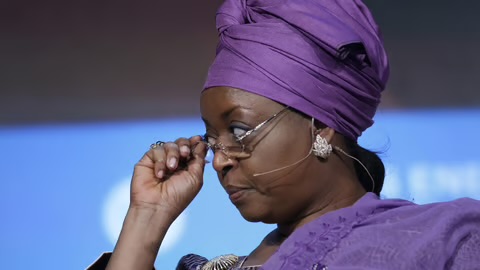
The ruling by Southwark Crown Court on 17 June, which brought to an end an 11-year investigation and prosecution in the United Kingdom, lifted the travel restrictions that had effectively kept Diezani Alison-Madueke in Britain for more than a decade. It has also reignited questions about whether Nigeria‘s long-running criminal cases against her can still proceed.
The first and only woman to serve as president of the Organisation of Petroleum Exporting Countries (OPEC) described the UK proceedings as “arduous, emotionally draining and traumatic”.
“I am profoundly relieved. My name has been cleared, and this ordeal has come to an end,” she told the BBC after the verdict.
The UK case, however, is only one chapter in a legal saga that began in 2015, shortly after the administration of former president Goodluck Jonathan, in which she served as petroleum minister, left office.

Alison-Madueke left Nigeria for the UK in 2015, shortly before the Economic and Financial Crimes Commission (EFCC) moved against her. The anti-corruption agency subsequently filed at least two criminal cases, including one containing 13 counts of alleged money laundering, before embarking on a series of civil forfeiture proceedings.
In October 2017, a Lagos court ordered the permanent forfeiture of 58 houses that the EFCC said she acquired for $22m between 2011 and 2013, using front companies.
Two years later, another Lagos judge ordered the forfeiture of 2,149 pieces of jewellery and a customised gold iPhone recovered during a raid on her Abuja residence.
In between, other assets, including a $37.5m mansion on Banana Island, Lagos, and a 15-storey luxury residential building comprising 18 flats and six penthouses in Foreshore Estate, Ikoyi, were also seized.
According to the EFCC, jewellery valued at about N14.6bn ($10.6m) and properties worth roughly $80m were forfeited under court orders obtained between 2016 and 2019. Between 2022 and 2023, the commission auctioned some of the assets.
What is Alison-Madueke’s next step?
Freed from the UK proceedings, Alison-Madueke’s immediate priority is a lawsuit filed in 2023, challenging the forfeiture of the assets, many of which have already been sold.
She is asking the court to compel the EFCC to recover the assets from their purchasers. She argues that the forfeiture proceedings violated her constitutional right to a fair hearing because they were conducted without giving her an opportunity to defend herself. She also maintains that the confiscations cannot stand because she has never been convicted of any criminal offence.
“A mere allegation by the respondent that the act or action of the applicant constituted unlawful activities will not suffice in the circumstances,” she said in court filings.
The EFCC, however, maintains that the forfeiture orders were lawfully obtained on the strength of pending criminal charges against her in Abuja and Adamawa State.
A decade-long legal stalemate
For years, Alison-Madueke’s bail conditions in the UK since her arrest in 2015 prevented Nigerian authorities from bringing her before the courts. Although the EFCC sought her extradition, British authorities refused to release her while the UK criminal case was still underway.
In 2017, a team of EFCC investigators led by Abdulrasheed Bawa travelled to the UK to question Alison-Madueke. The commission later said her lawyers prevented investigators from interviewing her. Bawa was dismissed as EFCC chairman in 2023 by President Bola Tinubu over allegations of corruption.
Then acting EFCC chairman Ibrahim Magu repeatedly complained that the protracted UK proceedings had stalled Nigeria’s prosecution.
In an unexpected twist, Alison-Madueke twice approached Nigerian courts seeking orders directing the attorney general to facilitate her return to face trial. One of the applications arose in a criminal case involving her associate, Jide Omokore, and six others.
The EFCC opposed the applications, arguing that they were intended to help her evade justice in the UK and frustrate the criminal proceedings pending in Nigeria. At one stage, a Nigerian judge threatened to strike out one of the criminal cases because of the EFCC’s inability to produce Alison-Madueke for arraignment.
Alison-Madueke also filed a N100bn ($72.7m) defamation suit against the anti-graft agency.
Does the UK acquittal change Nigeria’s case?
Her lawyer, Mike Ozekhome, did not respond to enquiries from The Africa Report on whether Alison-Madueke intends to return to Nigeria to pursue her legal challenges. The EFCC has also remained guarded about its next move.
“I don’t want to talk about that now,” EFCC spokesman Dele Oyewale told The Africa Report when asked whether the commission would revive efforts to prosecute the former minister.
In court filings submitted in early July, Alison-Madueke formally presented the Southwark Crown Court judgment in support of her application challenging the forfeiture orders, describing the UK ruling as being of “obvious material relevance” to the allegations repeatedly relied upon by the EFCC.
She nevertheless stressed that she was not asking the Nigerian court “to sit on appeal over the said foreign decision or to treat the same as automatically conclusive of the Nigerian proceedings.”
The EFCC argues that the Nigerian case is fundamentally different. According to the commission, its charges relate primarily to alleged money laundering rather than bribery.
“The money laundering charges for which Madueke is answerable to the EFCC cover jurisdictions in Dubai, the UK, the US and Nigeria,” the agency previously said. It also remains unclear whether the arrest warrant issued against Alison-Madueke years ago is still in force.
International lawyer Femi Aina, who practises in the UK, says the acquittal could nevertheless strengthen Alison-Madueke’s defence should Nigerian prosecutors decide to proceed with the pending charges.
“The Nigerian government assisted the UK in her London trial by furnishing evidence against her,” Aina says. “That may give her grounds to argue abuse of process or even double jeopardy if the Nigerian prosecution relies substantially on the same evidence already tested in the UK.”
Whether Nigerian courts accept that argument could determine not only the fate of the outstanding criminal cases but also Alison-Madueke’s bid to recover assets that have become some of the most prominent forfeitures in Nigeria’s anti-corruption campaign.
(The Africa Report)
-

 Politics10 hours ago
Atiku’s Lobbyist Deletes Post On Purported Trump Commission Appointment
-
Politics9 hours ago
Tinubu’s policies improving student welfare, says NANS
-
News9 hours ago
Lab test showed my wife’s fresh orange juice unfit for consumption – Osinbajo
-
Politics10 hours ago
World Igbo Congress warns politicians against threatening Igbos over support for Obi
-
Politics10 hours ago
I am confident I will become Lagos governor next year – NDC gov candidate, Doherty
-
Business10 hours ago
Nigeria’s syndicated loans jump 21-fold to $2.86bn
-
Metro10 hours ago
Nigerian-British businessman dies after penis enlargement procedure in Thailand
-
Metro10 hours ago
Kogi chief allegedly impregnates teen, damages womb