Opinion
Has Tony outgrown UBA?

When I joined Nigeria’s international development sector at the beginning of the second decade of the 2000s, one of the first things that unsettled me was the culture of first-name calling. I remember struggling to call the then Head of Development Cooperation simply by his first name, David. Everything in my upbringing and professional conditioning resisted it. Here was a considerably senior official, occupying a position of authority, yet the expectation was that I should address him by his first name.
I adjusted, but never completely. Close to two decades later, I still find it difficult to call my bosses by their first names. I retreat to titles, NPM for National Programme Manager, NTL for National Team Lead, or sometimes simply “Boss” or “Egbon”. There is something deeply Nigerian about this. Names sit within an architecture of age, authority, social distance and respect. Someone may insist that you call him John, yet instinct continues to tell you that there ought to be a “Sir” somewhere.
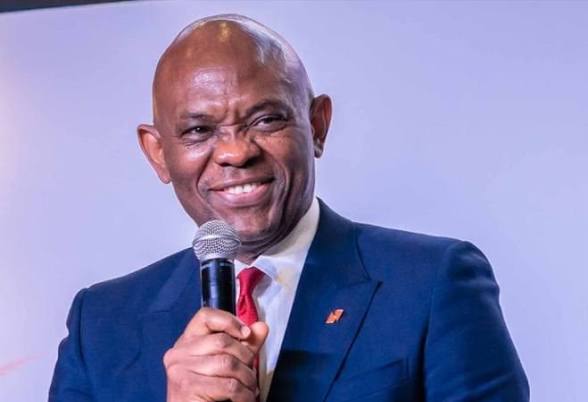
That was the background against which I watched the recent exchange between Tony Elumelu and a young UBA trainee. The young woman greeted him, “Good morning, Tony”, and he immediately corrected her. Not Tony, he said, but Mr Elumelu or TOE. The exchange has since generated the expected debate around respect, age, hierarchy and corporate etiquette. I understand the discomfort with first-name calling because I still experience it myself, but the more interesting question for me is whether Tony has, in some respects, outgrown UBA.
Tony Elumelu was not merely a beneficiary of the more informal corporate culture that emerged in Nigeria from the 1990s and early 2000s. He was one of its prominent expressions. In 2019, UBA’s own Lion King magazine carried a profile of him under the heading, “MY NAME IS TONY.” The story recalled an encounter in which a visitor addressed him formally as Chairman Elumelu, only for him to respond, “My name is Tony.”

That anecdote captured something about the corporate identity associated with him. The generation of bankers represented by Standard Trust Bank and later UBA helped reshape Nigerian corporate life. They were younger, less ceremonious and more impatient with inherited hierarchies. Their organisations placed greater emphasis on performance, mobility and access, and titles carried less weight than they had in many older institutions. Tony was part of that transition.
Accounts from the Standard Trust Bank years also speak to an environment in which younger officers could challenge managers, where age was not supposed to become an instrument of intimidation, and where hierarchy was deliberately softened. Seen against that history, the trainee’s greeting becomes more revealing than it first appears. She may simply have acted within a culture she understood to be normal, while the expectations of the man who helped shape that culture may have evolved.
Organisations have a way of preserving the instincts of their founders long after the founders themselves have changed. A leader builds an organisation at a particular stage of life. He may encourage informality because he wants ideas to move faster, flatten hierarchy because he wants younger people to speak, or resist elaborate titles because he wants performance to matter more than ceremony. Over time, these behaviours become habits, habits become culture, and culture becomes institutional memory.
The founder, meanwhile, continues to evolve. The ambitious executive becomes an elder statesman of business. His social standing changes, his networks deepen, his wealth expands, presidents engage him, governments seek him out, and thousands of entrepreneurs come to see him as a mentor. His name begins to carry an authority far beyond the office he once occupied. At that point, “Tony” may begin to sound different to Tony Elumelu, even while the organisation still hears the name in the way it was originally taught to hear it.
That is where the tension lies. An institution can preserve an earlier version of its founder long after the founder has moved beyond that version of himself. There is nothing unusual about personal evolution. Age, experience and accomplishment alter how people relate to authority, status and respect. The challenge begins when this evolution is not reflected in the institutional norms people are expected to follow.
If first-name calling is no longer appropriate, that norm should be clarified. If it applies among colleagues but not to the Chairman, the distinction should be understood. If formal occasions require a different etiquette, that too should become part of the culture. Otherwise, younger employees are left to navigate unwritten rules beneath the written ones.
This is not unique to UBA. Many Nigerian organisations carry similar contradictions. They speak the language of flat structures while maintaining layers of deference. They encourage openness while employees still calculate how much openness hierarchy can tolerate. They tell younger professionals that titles do not matter, yet everyone knows that context matters enormously. The result is a culture that often operates through signals rather than rules.
Experienced professionals learn to read those signals. They know when informality is genuinely permitted, when hierarchy has merely gone quiet, and when a title suddenly becomes necessary. A young trainee may not yet possess that instinct, which is why I am reluctant to make her the subject of the story. She merely stepped into a contradiction that was already there.
The more interesting question is what happens when an organisation remains faithful to habits its founder once encouraged while the founder’s own expectations have shifted. Perhaps that is what the exchange exposed. Tony may not simply have outgrown a style of address. He may, in some respects, have outgrown the organisational culture that once made “Tony” possible, and if that is true, UBA may eventually have to decide whether it is preserving the culture of the man who built it or adapting to the man he has become.
Henry Anibe Agbonika writes from Abuja, Nigeria. He can be reached via henry.agbonika@gmail.com
-

 News13 hours ago
UK universities withdraw admission offers to Nigerians over visa crackdown
-
Politics13 hours ago
2027: Protest, relief as INEC releases final candidates’ list
-
News13 hours ago
Benue: Suspected herdsmen kill nine in fresh Ukum attacks
-
News13 hours ago
Why kidnappers target NYSC members — Security experts
-
Politics13 hours ago
2027: Opposition, APC clash over campaign funding
-
World News13 hours ago
US gunman shoots dead 7 relatives, family friend
-
Opinion13 hours ago
Did Obi actually win in 2023?
-
Business13 hours ago
Fitch revises Nigeria’s outlook to positive, affirms ‘B’ rating