Politics
Electoral Act: Amendment yet to be concluded – Akpabio tells critics

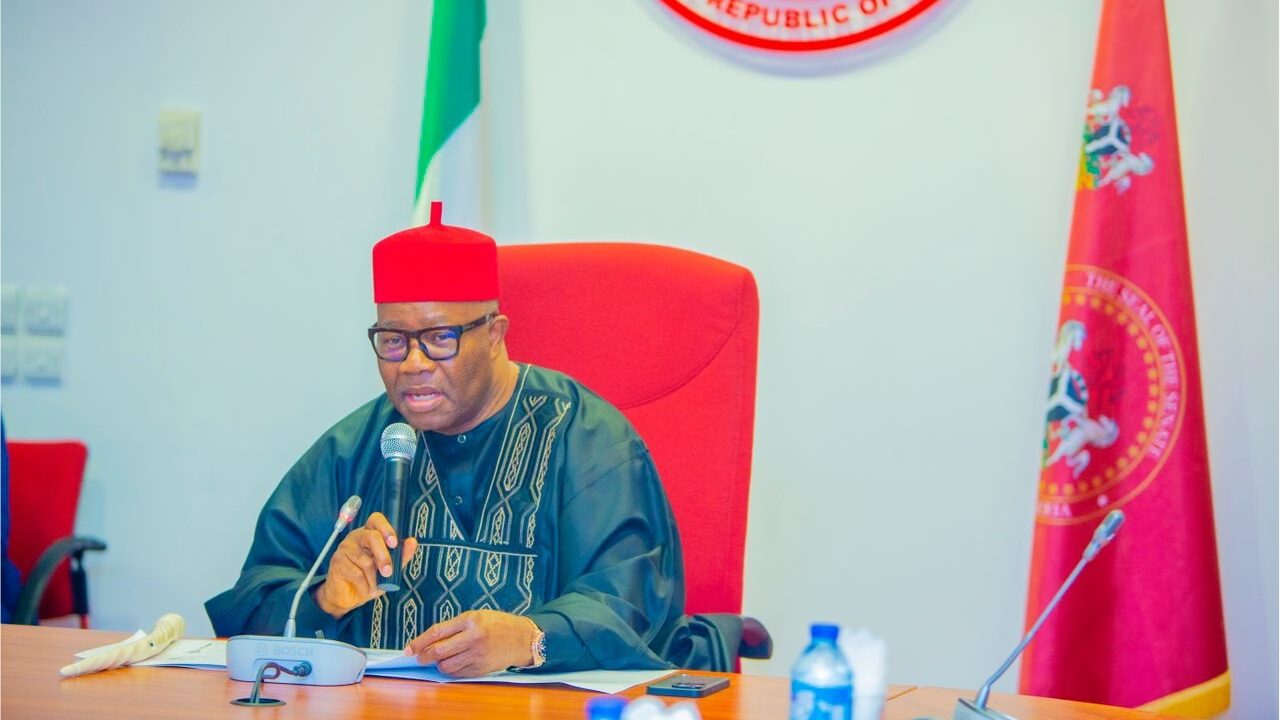
Senate President Godswill Akpabio has said the amendment of the Electoral Act 2022 is still ongoing and that there’s still room for adjustments.
Mr Akpabio stated this in Abuja on Saturday at the launch of a book titled ‘The Burden of Legislators in Nigeria’ authored by a former senator, Effiong Bob. The book was published by Premium Times Books.
PREMIUM TIMES reported that upper chamber had on Wednesday passed the Electoral Act Amendment Bill during which it rejected the transmission of election results from polling units to the Independent National Electoral Commission (INEC)
It also reduced electoral timelines like notice period and deadlines for political parties.

The upper chamber recommended a clause permitting voters to download missing or unissued Permanent Voters’ Cards (PVCs) and rejected a proposed 10-year jail term for the buying and selling of PVCs.
Since passing the bill, the upper chamber has come under heavy criticisms from some Nigerians, civil society organisations and opposition parties.
They described the decisions as a major setback for electoral integrity and democratic accountability in Nigeria.
Process not completed
Acknowledging that the Senate has faced immense criticism since Wednesday when it passed the Electoral Amendment Bill the senate president assured that the process has not been completed.
He said the upper chamber has a series of processes from the time a law is introduced to the time it is passed to the president for assent.
“In this case, we are yet to complete the process,” he said.
“So why are people setting up panels in all television studios…and then people have become mouth legislators.”
Mr Akpabio also said the upper chamber did not reject the use of electronic transmission of election results as reported.
He explained that the National Assembly has a harmonisation committee, also known as conference committee, which would either reject or accept the clauses in the law from both of the chambers of the legislature.
He said the Senate will approve the votes and proceedings before the conference committee can receive the draft to do its work.
“When we bring out the votes and proceedings, any senator has a right to rise up and say ‘in clause three, this was what we agreed upon’. And if those who are recording verbatim disagree or agree, we amend it before we approve the votes and proceedings,” he said.
“That is the only time you can now talk about what the Senate has done or what the Senate has not done.”
The senate president said the upper house would ensure it reflects the will of Nigerians and what is right for the country.
We didn’t reject electronic transmission — Akpabio
Mr Akpabio reiterated that the Senate did not reject electronic transmission of election results in the Electoral Act and that it only removed the clauses that make it mandatory for the Independent Electoral Commission (INEC).
According to him, the decision to remove the phrase ‘real time’ was to avoid legal conundrum that could arise when network or technological failure results in the delay of the transmission of results.
He said the decision to transmit the result either electronically or otherwise rests on the INEC, which implements the electoral laws.
“All we said during discussion was that we should remove the word ‘real-time’ because if you say real-time, then there is a network or grid failure and the network is not working. When you go to court, somebody will say it ought to have been real-time. That was all we said.
“Then we leave the burden to those who conduct the elections, INEC. INEC would determine the mode of transfer or transmission of votes,” he added.
Earlier denial
Earlier on Wednesday, Mr Akpabio had denied that the Senate rejected electronic transmission of results.
“Distinguished colleagues, the social media is already awash with reports that the Senate has literally rejected electronic transmission of results. That is not true. What we did was to retain the electronic transmission, which has been in the Act and was used in 2022.
“So please, do not allow people to confuse you. If you are in doubt, we will make our final votes and proceedings available to you if you apply. This Senate under my watch has not rejected the electronic transmission of results. It is in my interest as a participant in the next election for such to be done. So please don’t go with the crowd.
“We have retained what was in the previous provision by way of amendment. That was all we did. The previous previous has made allowance for electronic transmission. So it is still there as part of our law. We cannot afford to be going backwards,” he said.
-

 Politics24 hours ago
Obidients mobilise for #OccupyINEC protest
-
Politics24 hours ago
Talks intensify as Bauchi gov delays ADC defection
-
Business24 hours ago
Bakare announces full repayment of N4bn Wema Bank loan
-
News16 hours ago
Fire Service CG’s Massive Convoy Sparks Reactions
-
 Politics24 hours ago
Cracks Among Daura APC Stakeholders Over Endorsement Of Buhari’s Son, Others
-
Metro24 hours ago
PHOTOS: Policemen Murdered By Boko Haram Laid To Rest
-
Metro16 hours ago
Rivers: One Killed As Rival Cult Factions Clash Over Girlfriend
-
Metro24 hours ago
Plateau Crisis: Residents Who Saved Christians, Muslims Rewarded With N1m