
Business
Dangote cuts petrol gantry price to lowest in four months

…Gantry petrol price now N1,070/litre
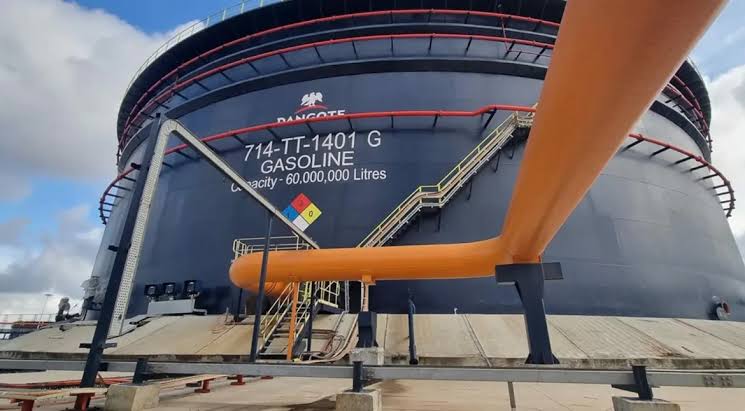
Dangote Petroleum Refinery has reduced its petrol gantry price to N1,070 per litre through its consortium marketers, taking the rate to its lowest level since July 2026 as the refinery extends a series of price cuts in the downstream market.
The latest reduction represents a drop of N60 per litre from the N1,130 per litre rate announced on Wednesday, November 18, according to market checks by energy research firm Petroleumprice.ng.
The adjustment marks a reversal from the higher prices recorded in recent months, when Dangote’s petrol gantry price climbed above N1,200 per litre and reached N1,300 on November 3 following the introduction of a fixed-naira pricing arrangement.
The refinery subsequently returned to an EBOB-linked pricing structure, triggering roughly six successive reductions within the month before the latest adjustment.

At N1,070 per litre, the new rate is below the N1,165 recorded in August, when the refinery reduced its gantry price from N1,215. It is also the lowest since July, when Dangote cut its ex-depot price by N50 to N1,075 per litre.
The July adjustment preceded a temporary shift to dollar-denominated petrol pricing at $0.779 per litre on July 13. The refinery resumed naira-denominated loading two weeks later, on July 23, with its ex-depot price rising to N1,215 per litre.
The latest price movement comes as international crude oil prices remain below $100 per barrel, despite renewed gains driven by security concerns around the Strait of Hormuz.
As of the time of writing, Brent, Nigeria’s benchmark crude, traded at $91.67 per barrel, while West Texas Intermediate, the US benchmark crude, settled at $82.58.
Oil prices have faced competing pressures from concerns over potential supply disruptions and expectations of a global surplus. Rising OPEC+ production, resilient Russian exports and increasing US crude inventories have reinforced expectations of stronger global supply.
However, crude shipments from the Persian Gulf remain below pre-war levels, despite recovering from disruptions in the early months of the conflict.
Vortexa, an energy analytics firm, said this week that Iran had designated more than half of the tankers Gulf oil exporters use to transport crude through the Gulf of Oman to international markets.
The firm said the restrictions had not yet significantly reduced oil volumes moving through the shuttle-transfer system, as exporters adapted through additional ship-to-ship transfers.
Analysts at ING Commodity, a commodity trading agency, have identified further disruptions around the Strait of Hormuz as an upside risk to oil prices. However, they said rising OPEC+ production, resilient Russian exports and growing US inventories point to a more comfortable global supply outlook.
The latest reduction could intensify competition among fuel suppliers and create room for further price adjustments across Nigeria’s downstream market.
However, the extent to which the lower gantry price translates into cheaper petrol at depots and filling stations will depend on the pricing decisions of marketers, distribution costs and prevailing market conditions. (BusinessDay)
-

 African News21 hours ago
South Africans Demand Total Ban On Nigerians In Fresh Protest
-
News20 hours ago
BREAKING: Court restrains Jimmy Odukoya from parading himself as senior pastor of Fountain of Life Church
-
Metro20 hours ago
Man accused of AI cheating in South Korean exam found dead
-
Business15 hours ago
Fidelity Bank appoints Stanley Amuchie as new CEO
-
Business19 hours ago
Inside Nigeria’s trillion-naira pipeline security system where oil theft persists
-
Business8 hours ago
Naira slides to N1440/$ as foreign reserves shed $406m
-
Business8 hours ago
Kola Karim’s $10bn ambition: Building Nigeria’s answer to Tata
-
News19 hours ago
Tinubu confers GCON on Wole Olanipekun