News
91 Days After, El-Rufai Remains In Detention

Ninety-one days after security operatives arrested former Kaduna State governor Nasir El-Rufai, he remains in detention despite securing separate bail approvals from high courts in Kaduna State and Abuja, Daily Trust reports.
This is even as family members, political associates and stakeholders have faulted the stringent bail conditions imposed on El-Rufai, a chieftain of the African Democratic Congress (ADC), insisting that his three-month incarceration is politically motivated.
While the ADC said the former governor was being treated like a “political prisoner” despite voluntarily submitting himself to authorities, the Muslim Rights Concern (MURIC) described his continued detention as “deplorable.”
Similarly, former Deputy National Chairman of the Peoples Democratic Party (PDP), Chief Olabode George, called for El-Rufai’s immediate release, warning that stringent bail conditions should not be used to deny him freedom.

George, who described the judiciary as the “last hope of the common man,” said Nigeria must remain committed to the principles of justice, fairness and the rule of law.
Daily Trust reports that on Monday, February 16, the former governor honoured an invitation extended to him by the Economic and Financial Crimes Commission (EFCC), where he was grilled by detectives before later being handed over to another security agency.
This came after security operatives allegedly failed to arrest him at the Abuja airport upon his return from Egypt.
On Wednesday, February 18, reports emerged that operatives of the Department of State Services (DSS) had taken El-Rufai into custody.
However, on Thursday, February 19, the Independent Corrupt Practices and Other Related Offences Commission (ICPC), in a terse statement by its spokesman, John Odey, confirmed that the former governor had been taken into its custody, where he has remained ever since.
El-Rufai, who was arraigned on April 23 for allegedly intercepting phone conversations linked to the National Security Adviser (NSA), Nuhu Ribadu, pleaded not guilty to the charges.
The DSS, in a further amended charge marked FHC/ABJ/99/2026, preferred a five-count charge against the former governor.
What transpired in Abuja court on Monday
On Monday, the former governor was brought to the premises of the Federal High Court in Abuja at about 8.50am by stern-looking DSS operatives, who had earlier cordoned off the court surroundings.
Journalists, court staff and other users of the premises were initially prevented from entering shortly after El-Rufai arrived, a development that triggered a brief protest.
Leading the protest, activist and former presidential candidate of the African Action Congress (AAC), Omoyele Sowore, argued that the court is a public institution and should not bar Nigerians interested in observing proceedings.
Speaking anonymously to Daily Trust, a staff member of the ICPC disclosed that DSS operatives arrived at the anti-graft agency’s facility as early as 7am to pick up the defendant for arraignment.
“Yes, the ongoing case in court is not our case. They (DSS operatives) came to pick him up here at about 7am in order to arraign him in court,” the source said.
Stringent bail conditions
Following the brief drama outside the court premises, Justice Joyce Abdulmalik granted El-Rufai bail in the sum of N100 million with one surety in like sum.
The judge granted bail after counsel to the DSS, Oluwole Aladedoye (SAN), did not oppose the application filed by El-Rufai’s lawyer, Oluwole Iyamu (SAN).
Outlining the conditions, Justice Abdulmalik stated that the surety must reside in either Maitama or Asokoro in Abuja and must deposit the original Certificate of Occupancy of a landed property with the court.
The court further directed that the surety must be a federal civil servant not below Grade Level 17 and provide proof of salary payments for at least three months.
The surety is also required to submit an affidavit of means, enter into a bail bond and provide a recent passport photograph, alongside a verification letter from their department and a tax clearance certificate covering the last six months.
Justice Abdulmalik also ordered El-Rufai to surrender all valid international passports and report to the headquarters of the DSS every last Friday of the month by 10am to sign an attendance register pending the determination of the case.
The court warned that any breach of the conditions would lead to an automatic revocation of the bail.
Family reacts
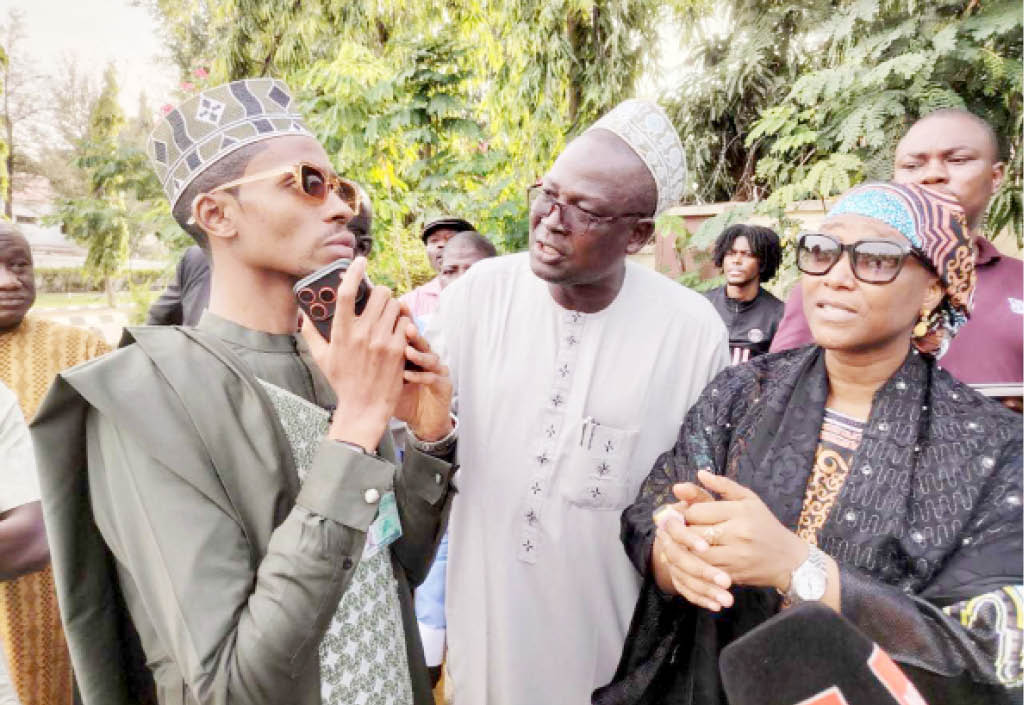
Speaking on the development, El-Rufai’s wife, Hasiat, who addressed journalists outside the DSS headquarters in Abuja, said the family had been traumatised by the situation and now lived under constant threats and surveillance.
“We now live in constant fear. Every day we get a threat — DSS is coming to raid your house, ICPC is coming to raid your house, police are coming to raid your house. You are being followed. Our phones are tapped,” she said.
Hasiat also alleged that El-Rufai, who has spent 91 days in custody, had been denied access to his personal physicians despite a Kaduna State High Court order by Justice Aikawa granting him unfettered access to his lawyers and doctors.
She explained that the ICPC’s in-house doctor had recommended medical tests for El-Rufai, after which it was agreed that his doctors would return to discuss the results with him.
Similarly, El-Rufai’s son and member of the House of Representatives, Bello, described the matter as politically motivated.
He questioned the stringent bail conditions, which he said were deliberately designed to be difficult to meet.
“Who keeps a person for 91 days? Why were the terms of the bail so stringent that it is practically impossible for anybody to meet? Why do you have to say that Kaduna State Council of Chiefs will have to give an attestation?
“Why are we saying that it has to be a government staff of Level 17, with a house in Asokoro or Maitama? Which civil servant has N100 million?” the lawmaker queried.
We’re not witch-hunting El-Rufai, ICPC replies family
Reacting to the allegations levelled against the commission, ICPC spokesman John Odey, during a press briefing, described the claims by El-Rufai’s family members as “false,” challenging them to present evidence if they were truly denied access to him.
The agency also denied allegations of political witch-hunt, maintaining that the former governor remained in custody because he had yet to meet his bail conditions.
Odey, a deputy director and Head of Media and Public Communications at the ICPC, also refuted claims that the commission had disobeyed any court order.
He maintained that El-Rufai’s continued detention was not politically motivated but strictly a matter of law and compliance with bail conditions.
“He is in the custody of ICPC as remanded by a court of competent jurisdiction and he is doing very well. He is fine and in good health,” Odey said.
Asked whether El-Rufai would be released based on the bail granted on Monday, Odey said: “That is for the judicial process to determine. For us, if he meets the bail conditions given to him in our matter, we have no reason to keep him further.
“The ICPC is not a political party. The ICPC does not play politics. It does not exist to play politics. The law establishing the ICPC is very clear.
“So, suggestions that the commission is targeting El-Rufai for political reasons are unfounded and misleading,” he said.
He also dismissed claims that the commission had ignored a court order for the former governor’s release, describing such allegations as inaccurate and misleading. (Daily trust)
-

 News21 hours ago
Outcry as fake products flood markets
-
Celebrity Gist21 hours ago
Okoye really sweet, Cardi B says after third sighting
-
News22 hours ago
N33.75bn Cash Transfer Mystery: FG Failed to Prove Millions of Vulnerable Nigerians Received Funds — Auditor-General
-
Business21 hours ago
Airport policies didn’t drive Uber out of Nigeria, says FAAN
-
Metro21 hours ago
Trafficker lures, sells 15 Nasarawa children